Hiring International Employees: Your Three Options, Compared

Ema Koloski

January 16, 2026

Key Takeaways From Hiring International Employees

    • Match your hiring model to your growth stage: Contractors for short-term work, EOR for fast multi-country hiring, entities for long-term regional hubs.
    • EORs balance speed with compliance: Onboard quickly across borders without heavy setup costs or legal complexity.
    • Classify workers correctly from the start: If you're setting hours and providing tools, they're employees. structure the relationship accordingly
    • Simplify global hiring with one platform: RemotePass handles onboarding, payroll, and compliance across 150+ countries so you can scale without the operational chaos. Book a 15-minute demo today.
  • Hiring international employees is a serious growth move. But the model you choose shapes how fast you hire, how much risk you take on, and whether your strategy can scale.

    Pick the wrong model, and you invite compliance headaches, especially in countries where you don’t know the rules.

    This guide breaks down your three options: contractors, legal entity, and Employer of Record (EOR). You'll see how each one works and what fits best for your stage of growth. 

    Before you choose your model, here’s what you could gain and what’s on the line if you get it wrong.

    Is It Worth It to Hire International Employees?

    Hiring international employees is one of the most strategic moves you can make. Because top talent isn’t local anymore. And your hiring model shouldn’t be either.

    That’s why companies of all sizes are building international teams. To move faster, hire better, and grow where others can’t. So what’s the real ROI of hiring international employees?

    You Hire Faster With Skills You Can’t Find At Home

    Fast-growing companies have critical staffing needs they can’t fill at home, especially in tech, product, and engineering roles.

    Global hiring widens your talent pool. From remote candidates to local experts in hard-to-reach markets, you skip the waitlist for scarce talent and go straight to the source. Anywhere in the world.

    You Get 24/7 Coverage With Timezone Diversity

    When your team spans time zones, work keeps moving even after one office clocks out.

    Global coverage gives support, ops, and customer teams a serious edge. And convenience is just the start. You also get faster resolutions and round-the-clock responsiveness.

    Make async the default. Keep work moving without waiting on anyone’s hours.

    You Enter New Markets With Locals Who Know The Ground

    If you’re serious about global expansion, you need people on the ground who understand the culture and local buying behaviors. 

    Hiring international employees can help you break into new regions faster, with fewer false starts and failed assumptions.

    Growing without local insight isn’t a strategy. It’s a shot in the dark.

    You Benefit From Global Cultures and Perspectives

    A truly diverse workforce brings sharper thinking and stronger decisions.

    Teams with international employees are better equipped to challenge assumptions and build products that serve a wider audience. 

    If you're building for a global market, you need people who actually live in it. 

    You Boost Your Global Employer Brand By Offering Real Protection

    The best talent expects flexibility and legal protection, no matter where they live.

    Offering secure employment helps you win candidates who care about stability and long-term growth. 

    And if you don’t offer that experience, another global company will. Your employer brand doesn’t stop at the border. Neither should your hiring standards.

    But building that reputation takes more than good intentions. You also need a strong system to back it up.

    Without the right structure, hiring international employees can expose you to compliance risks and missed opportunities in key markets, especially without a compliant international employment contract.

    The upside is real. But so are the stakes. To realize the benefits of hiring internationally, you need the right foundation, and that starts with choosing the right hiring model.

    EOR vs Entity vs Contractors: Your Three Options for Hiring International Employees, Compared

    The method you use to employ international hires affects how fast you can hire, how much risk you take on, your payroll setup, and how easily your strategy can scale.

    Most companies choose one of three paths:

    • Work with an Employer of Record (EOR)
    • Set up a local legal entity
    • Hire independent contractors

    Let’s start with the most flexible option: the EOR model.

    Option 1: Hire Through an Employer of Record (EOR)

    Let’s say you’ve found the perfect candidate, but they live halfway across the world. You don’t have a local entity. You don’t know the labor laws. And you definitely don’t want to delay the hire by six months, figuring it out.

    That’s where an Employer of Record (EOR) comes in.

    An EOR becomes the legal employer, handling everything from payroll taxes and employment contracts to Social Security contributions, local benefits, and full compliance with local labor laws.

    The EOR takes on legal employment responsibilities, while you retain management of daily work.

    When EOR Makes Sense:

    • You’re hiring <10 people in a new country
    • You need someone onboarded quickly (one to two weeks instead of two to six months)
    • You’re testing a market or making your first international hire
    • You’re not ready to set up a local legal entity for a few hires

    It’s the most flexible way to grow global teams without getting buried in compliance.

    That flexibility was key for Chaos, a fast-growing software company that needed to hire urgently in Vietnam, India, and Mexico, but had no local entities in place.

    Contractors were too risky. Entities weren’t worth the overhead for just a few hires. Chaos needed a fast, compliant way forward, so they chose RemotePass as their EOR.

    With RemotePass, they hired 15 employees across 9 countries, stayed fully compliant, and avoided ~$135K in setup costs.

    As their Director of People and Culture put it: “It makes more sense than establishing an entity. And for the employees, it means health insurance, social security, and all the standard benefits.”

    How EORs Work and Where the Trade-Offs Are

    When you hire international employees through an EOR, you’re outsourcing the legal framework, but not the relationship. 

    The EOR handles employment compliance and payroll, while you manage the person’s day-to-day work.
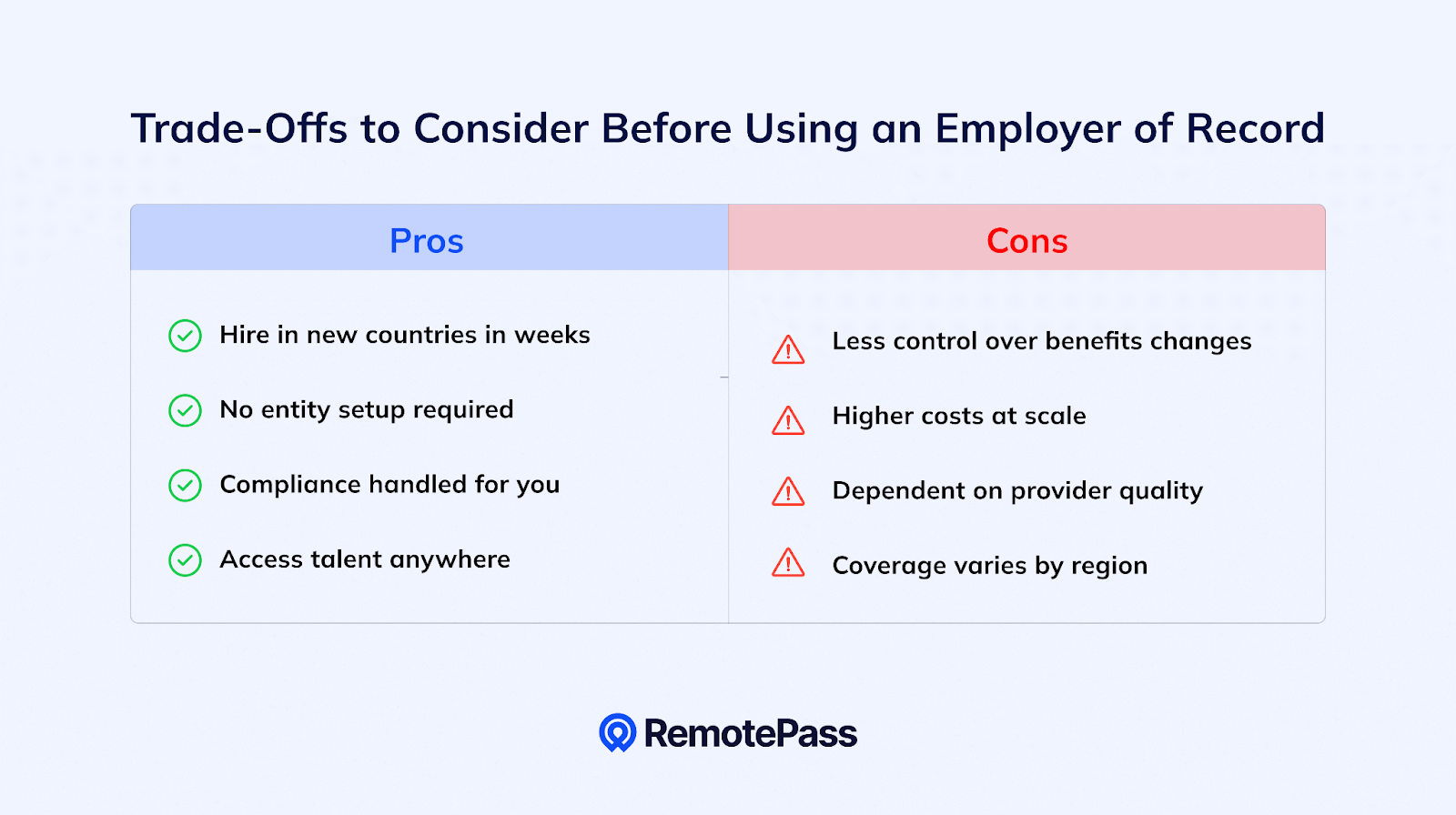
    Hiring international employees EOR trade-offs

    It’s fast, flexible, and scalable, but there are a few important trade-offs to understand:

    • Monthly cost: You skip setup fees and admin overhead, but you’ll pay $200–$600 per employee, per month.
    • Operational control, but limited legal authority: You manage the team’s work, but because the EOR is the legal employer, they issue the employment contract and enforce local labor laws. You may have less flexibility in in-country employment terms or equity structures that require a legal entity.
    • Low legal risk, high dependency: The EOR handles compliance, but you’re still dependent on their accuracy and up-to-date knowledge.

    Even with those trade-offs, the EOR model gives you a fast and compliant way to hire internationally, especially when your team is spread across multiple countries with just a few people in each.

    Without a system, managing international contractors quickly piles up admin work, from chasing contracts to dealing with classification risk. And if you’re setting up entities in every market, the overhead adds up fast.

    An EOR strikes the middle ground: you hire quickly and stay compliant without locking yourself into infrastructure you can’t maintain at scale.

    Option 2: Set Up a Local Entity

    At some point, using an EOR may no longer be the best fit. 

    If you’re hiring 10+ employees in a single country or planning a long-term presence with full control over compensation, a local legal entity can make more sense.

    A local entity gives you direct access to local talent and full responsibility for managing payroll and legal compliance in-country (many teams bring in local legal counsel just to keep everything straight).

    You become the legal employer, with all the obligations that come with it.

    Use this structure when you’re building a regional hub, hiring leadership, or working with enterprise clients who expect a formal local presence. 

    You get control. But you also take on a much larger compliance footprint.

    When Local Entity Makes Sense:

    • You’re hiring 10+ employees in one country
    • You’re building a long-term presence in that market
    • You want full control over payroll and compliance

    If you’re planting real roots in a country, a local entity gives you the control and permanence that flexible models can’t.

    What’s Actually Involved

    Setting up a local entity isn’t overly complex, but it is time-consuming and admin-heavy. You’ll need to:

    • Register the business and tax IDs
    • Build a compliant payroll infrastructure and reporting
    • Appoint a local director (in many jurisdictions)
    • Manage local employment contracts, benefits, and compliance filings

    Timelines vary, but entity setup typically takes two to six months.

    Upfront costs can range from $5,000 to $50,000+, depending on the country, legal complexity, and required third-party support.

    And the ongoing overhead, like managing local payroll and audits, adds up quickly.

    One more thing to watch for: setting up an entity may trigger Permanent Establishment (PE) risk, meaning corporate tax exposure before you even make a hire.

    Trade-Offs to Know

    • High setup cost and long timelines: You’ll spend serious time and money before you can even make a hire. This can slow down growth if you’re still testing the market.
    • Heavy operational burden: Unlike an EOR, you’re on the hook for everything from employment contracts to local compliance systems.
    • Full control, full liability: You gain long-term control over compensation and benefits, but also take on every legal and financial risk tied to local employment law.
    • Harder to unwind: Leaving the market isn’t simple. Shutting down an entity is far more complex than pausing an EOR engagement.

    Setting up an entity gives you more control, but it’s not always the strategic choice, especially if your international hiring strategy is still evolving across multiple countries.

    Local entities make sense when size, budget, and long-term commitment justify the complexity. Only build one if you’re planting roots.

    Option 3: Engage Independent Contractors

    Sometimes you don’t need a full-time employee. You just need someone to get a project done.

    Hiring independent contractors can help you move fast and fill skill gaps without adding long-term headcount.
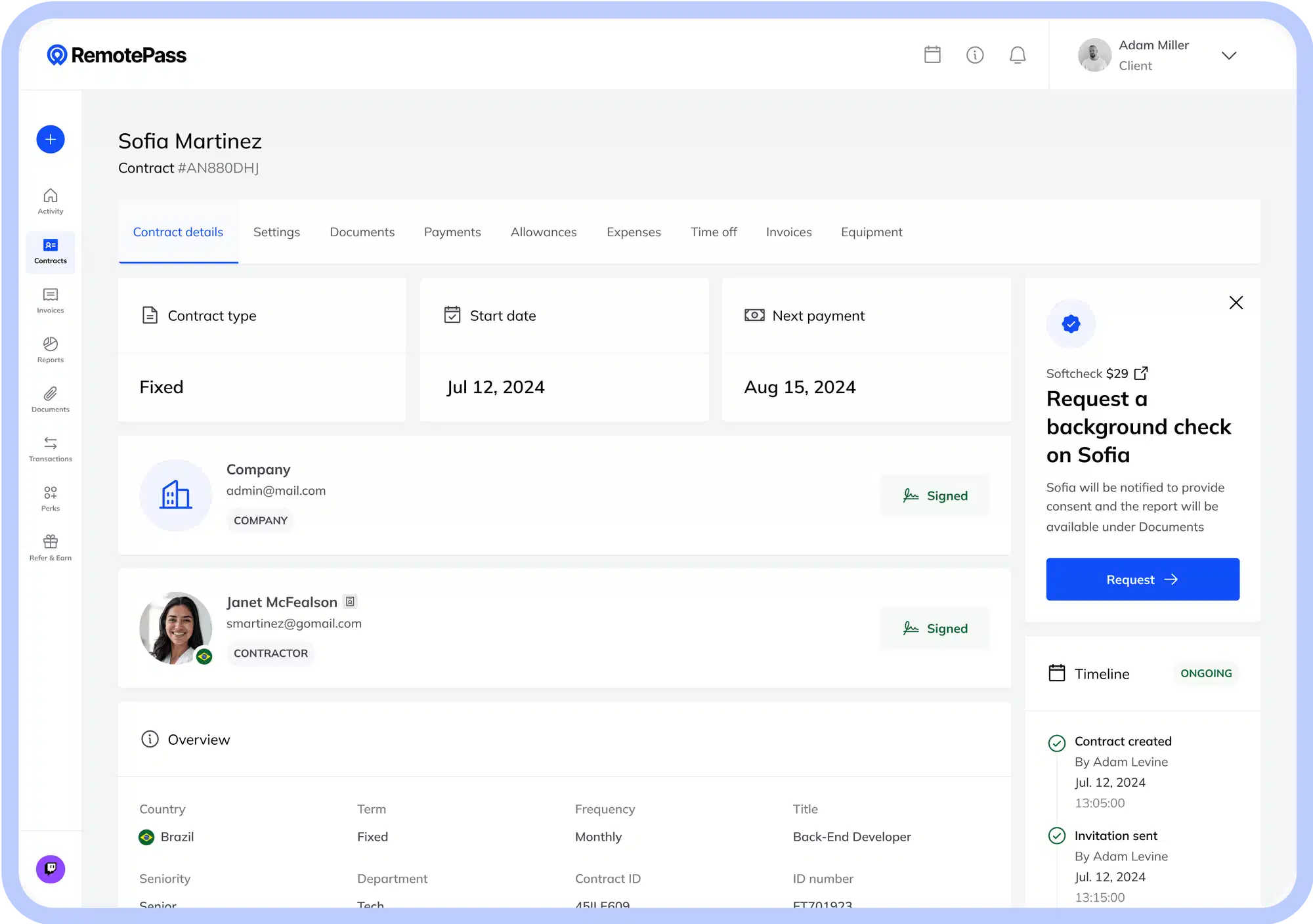
    Hiring international employees Remoteass contractor dashboard

    This model works well for short-term projects and flexible engagements that don’t require full-time oversight. It also helps early teams move forward without needing to build out full payroll or benefits infrastructure.

    You work with the contractor in a business-to-business relationship. They're invoicing you for their work and handling their own taxes, without access to full-time employee protections.

    It sounds simple until you're managing dozens of contractors across borders and hoping nothing slips through the cracks in your tax and compliance processes.

    That’s exactly what Alts Digital, a gaming tech company, ran into when its global team of 20+ contractors became a legal and administrative headache. 

    Between verifying tax documents every quarter and chasing down invoices across multiple countries, their People team was drowning in paperwork.

    With RemotePass as their Contractor of Record, they eliminated the compliance chaos, consolidated payments into a single transaction, and got their time back, without compromising on global talent.

    When Engaging Independent Contractors Makes Sense

    • You’re hiring for a clearly defined, short-term project
    • You’re not setting working hours or controlling how the work gets done
    • You’re testing a market or role before making a full-time hire
    • You’re working with global contractors who already operate as self-employed professionals

    In these cases, contractor engagements can save time and money. But they also come with risk, and many companies don’t realize when they’ve crossed the line.

    The Hidden Risk Behind Contractors

    Wanting to hire someone as a contractor doesn’t make it legal.

    It’s not the job title that matters. It’s how the relationship actually works. If you control the what, how, and when, they’re probably an employee.

    Too many teams slip up by assigning fixed hours or giving contractors company tools they shouldn’t have. It feels efficient, but it’s a textbook misclassification. And that comes with real consequences.

    If authorities find misclassification, they can demand back pay and impose serious legal penalties.

    Some countries audit aggressively. Spain, for example, fines companies up to €12,000 per misclassified contractor. Other governments, like Germany or France, look for red flags like long-term engagements or clear economic dependence.

    What starts as a flexible workaround can turn into a legal liability. Especially if you’re hiring them in multiple countries with no unified system in place to manage global contractors compliantly.

    Before you rely on this model, you need a clear plan for how it fits into your long-term hiring strategy.

    Trade-Offs to Know

    • Low commitment, but zero infrastructure: You skip setup fees and payroll systems, but you also get no built-in compliance or support if things go wrong.
    • High misclassification risk: The more control you exert, the more likely the relationship crosses into employee territory.
    • Limited access to top talent: Many professionals prefer the stability of employment,  with benefits and long-term security they can count on.
    • Scaling gets messy: Managing five contractors in five countries means five contracts, five tax rules, five separate compliance risks.

    Contractors can absolutely be part of your hiring strategy, but not as a stand-in for full-time employment. They are great for testing, but dangerous to build on.

    Whether you use an EOR, set up a local entity, or work with independent contractors, each model comes with trade-offs. What works for one hire might break when you scale.

    So how do you know which model is right for your next international hire, and the ones after that?

    The Decision Framework: How to Choose the Right Model When Hiring International Employees

    When you’re hiring across borders, the wrong model creates drag, either by slowing onboarding or piling on unnecessary overhead.

    This framework helps you cut through the complexity and choose a model that fits your growth stage and risk profile.

    You don’t need to become an expert in employment laws or labor compliance to make a smart decision. But you do need to ask the right questions.

    1. How Many People Are You Hiring In This Country?

    Fewer than 10 people? Use an EOR.

    10+? A local entity might make more financial sense, especially once recruitment costs and setup overhead begin to outweigh short-term flexibility.

    Just testing with a short-term contractor? That’s fine, as long as the structure is right.

    2. How Soon Do You Need Them Working?

    Need a remote hire to start in the next week or two? A local entity is out, setup takes months.

    If it’s a short-term project with minimal oversight, a contractor can work. But if the role is long-term or integrated with your team, an EOR is the safer choice.

    Contractors might be faster, but speed without structure risks misclassification.

    EORs strike the balance: fast onboarding with long-term compliance.

    3. Are You Testing The Market Or Going Long-Term?

    Testing? Stay flexible with contractors or an EOR.

    Committed to scale? Build the entity.

    4. Are They Truly a Contractor or Really an Employee?

    Your hire has set hours and uses company tools under your direction? That’s a strong signal they’re functioning like an employee, not a contractor.

    In that case, you’ll need to classify them as an employee, which means choosing between an EOR or setting up an entity.

    TL;DR: Three Models. Three Trade-Offs. A Side-by-Side Comparison

    Use this comparison table to audit your current hires or map your next international growth phase:

    Hiring Model Speed to Hire Cost Compliance Risk Best For
    Contractors Instant (if vetted) Cheapest upfront High: risk of misclassification Short-term work, market testing
    EOR One to two weeks $200-$600/employee/month Low: full compliance handled First hires, multi-country hiring, fast onboarding
    Local Entity Two to six months $5K–$50K+ setup + admin Medium: you own compliance Long-term presence, 10+ hires in one country

    Each model solves a different problem, so match the structure to your team’s stage, speed, and hiring volume.

    In short:

    • Contractors offer speed and low commitment, but risk grows with scale
    • EORs give you flexibility and compliance without heavy overhead
    • Entities give you full control but demand serious time and investment

    If you’re hiring across multiple countries, every one of these factors multiplies.

    Managing five contractors in five countries = five risk profiles.
    Setting up five entities = massive cost and time.

    The best global hiring strategy isn’t the fastest or the cheapest. It’s the one that won’t break when you scale.

    That’s where a unified EOR platform like RemotePass fits. It gives you a single system for onboarding, payroll, and compliance across the board, without needing to build legal infrastructure from scratch.

    But, even with the right model for hiring international employees in place, execution is where many companies stumble.

    What Can Go Wrong With Hiring International Employees (And How to Avoid It)

    Global hiring fails from poor execution, not intent. And picking the right hiring model is only half the work.

    Here’s where things tend to break, and how to handle them before they become expensive.

    Understanding Compliance Beyond Contracts

    “Follow local labor laws” sounds simple until you’re doing it.

    Every country has its own rules around employment terms and employee benefits. Some require a 13th‑month salary. Others enforce works councils, strict termination rules, or detailed mandates for paid leave and overtime.

    Compliance isn’t just about getting the employment contract right at onboarding. It also means:

    • Running local payroll correctly
    • Calculating and filing social contributions
    • Managing payroll taxes and compliance filings
    • Staying current with changing employment laws

    Miss one requirement, and regulators may hit you with fines or retroactive payments,  even if the mistake was unintentional.

    This is where EORs make a meaningful difference. 

    Instead of trying to interpret local labor laws country by country, companies rely on EORs to apply the right rules automatically and ensure compliance when hiring international employees throughout the entire lifecycle.

    Avoiding the Misclassification Trap

    Misclassification is one of the most common (and most costly) mistakes in international hiring.

    Governments don’t care what title you give someone. They look at how the relationship actually works. 

    Factors like control and economic dependence determine whether someone is legally an employee or an independent contractor.

    Watch for these red flags:

    • Fixed working hours
    • Exclusivity
    • Company-provided tools and systems
    • Ongoing work with no clear end

    You may be treating a contractor like an employee, whether you meant to or not.

    When misclassification happens, the consequences are serious:

    • Reclassification of the worker
    • Back pay for wages and benefits
    • Retroactive Social Security and social tax contributions
    • Fines, penalties, and legal fees

    Contractor hiring isn’t inherently risky, but it becomes a legal blind spot when it’s used as a stand-in for full-time roles or scaled without structure.

    If you wouldn’t treat them like a contractor at home, don’t treat them like one abroad. The penalties are global.

    Learning How to Lead Teams Across Time Zones and Cultures

    Hiring globally means navigating more than laws and payroll. It also means learning how to work across time zones and cultures.

    With an eight‑hour time difference, asynchronous work becomes the default, but only if you build the right systems:

    • Clear documentation and written decisions
    • Overlapping hours for critical meetings
    • Rotating meeting times to avoid burnout
    • Async‑friendly tools like Notion, Loom, and Slack

    But logistics are just the surface. Cultural differences, like how feedback’s given, how hierarchy works, and how disagreement shows up, cause real friction when teams aren’t prepared for them.

    What often looks like a productivity issue is really a communication mismatch.

    One practical fix is setting core hours, usually two to four hours a day when everyone overlaps. Combined with strong documentation, this reduces meeting overload and keeps teams aligned without forcing someone into 6 a.m. or 10 p.m. calls every day.

    Audit your workflows. How many meetings are you holding simply because async systems aren’t in place?

    Managing Multi-Country Complexity

    Hiring in one country is manageable. Hiring in several at once is where complexity compounds.

    There’s no such thing as a global standard for employment. Each country has its own regulations, payroll systems, and tax rules.

    Eight contractors in eight countries? Eight risk profiles. Minimum.

    Setting up three or four local entities means maintaining three or four payroll systems, compliance setups, and tax frameworks.

    This is where many companies hit a wall, especially when they try to apply their home‑country practices abroad. What worked locally doesn’t translate globally.

    That’s why smart teams consolidate ops as soon as hiring goes global. Doing all this manually, across five systems, five time zones, and five tax codes, is a recipe for burnout.

    This is where an EOR service like RemotePass becomes useful: it gives you a single place to track onboarding, handle global payroll, and stay compliant, without building new workflows from scratch for every country.

    Smart global hiring isn’t just about choosing the right hiring model. It’s about using that model well. The risks are real, but they’re manageable when you lead with structure, not speed. 

    Choose the right model, avoid the common traps, and build a system that scales across borders, not one that breaks under them.

    You’ve Got the Options. You Know the Trade-Offs. Now It’s Time to Make the Right Move

    Hiring international employees gets easier once the options are clear, but the decision still matters. The model you choose shapes how fast you can hire, how much risk you carry, and how easily your approach can scale.

    Contractors are great for short-term projects. Local entities suit long-term commitments. For most teams, an EOR offers the right balance between fast onboarding and legal peace of mind.

    You get built‑in compliance and the flexibility to scale without locking yourself into heavy infrastructure too early.

    That’s where RemotePass fits in.

    When you’re ready to make your first (or fifth) international hire, RemotePass helps you move fast and stay compliant as you grow.

    We handles the messy stuff: local employment laws, onboarding, tax filings, payroll, and benefits for full-time employees. Plus contractor management and compliance when you need it. All in one place.

    Scale across borders in 150+ countries, without legal baggage or compliance fear. Book a demo and get started in days, not months. 

    Hiring international employees isn’t just doable. It’s your next competitive move. 

    FAQs About Hriring International Employees

    Can I convert a contractor to a full-time international employee later?

    Yes, and many companies do. If you’re making that switch, a platform like RemotePass can help convert them compliantly and avoid misclassification risks.

    Do international employees need work Visas or employment authorization?

    Yes. In most countries, employees must have the legal right to work, either through a valid work visa, residence permit, or local employment authorization. This may involve visa sponsorship, employer registration, or proof of eligibility.

    Immigration rules vary by country, role, and nationality, so check them early to avoid delays or penalties.

    What documents do I need to hire someone abroad?

    It depends on the country, but you'll typically need a signed employment contract, proof of identity, work authorization, and banking details.

    Platforms like RemotePass manage country-specific requirements and ensure full legal and tax compliance.

    Can I pay international employees in their local currency with an EOR?

    Yes. Most EORs support multi-currency payroll, so you can pay employees in their local currency without setting up international banking. 

    RemotePass handles payments, exchange rates, and compliance behind the scenes.

    Table of Contents

    Need help onboarding, hiring, and paying global teams?

    15 min demo15 min demo

    Hiring international employees is a serious growth move. But the model you choose shapes how fast you hire, how much risk you take on, and whether your strategy can scale.

    Pick the wrong model, and you invite compliance headaches, especially in countries where you don’t know the rules.

    This guide breaks down your three options: contractors, legal entity, and Employer of Record (EOR). You'll see how each one works and what fits best for your stage of growth. 

    Before you choose your model, here’s what you could gain and what’s on the line if you get it wrong.

    Is It Worth It to Hire International Employees?

    Hiring international employees is one of the most strategic moves you can make. Because top talent isn’t local anymore. And your hiring model shouldn’t be either.

    That’s why companies of all sizes are building international teams. To move faster, hire better, and grow where others can’t. So what’s the real ROI of hiring international employees?

    You Hire Faster With Skills You Can’t Find At Home

    Fast-growing companies have critical staffing needs they can’t fill at home, especially in tech, product, and engineering roles.

    Global hiring widens your talent pool. From remote candidates to local experts in hard-to-reach markets, you skip the waitlist for scarce talent and go straight to the source. Anywhere in the world.

    You Get 24/7 Coverage With Timezone Diversity

    When your team spans time zones, work keeps moving even after one office clocks out.

    Global coverage gives support, ops, and customer teams a serious edge. And convenience is just the start. You also get faster resolutions and round-the-clock responsiveness.

    Make async the default. Keep work moving without waiting on anyone’s hours.

    You Enter New Markets With Locals Who Know The Ground

    If you’re serious about global expansion, you need people on the ground who understand the culture and local buying behaviors. 

    Hiring international employees can help you break into new regions faster, with fewer false starts and failed assumptions.

    Growing without local insight isn’t a strategy. It’s a shot in the dark.

    You Benefit From Global Cultures and Perspectives

    A truly diverse workforce brings sharper thinking and stronger decisions.

    Teams with international employees are better equipped to challenge assumptions and build products that serve a wider audience. 

    If you're building for a global market, you need people who actually live in it. 

    You Boost Your Global Employer Brand By Offering Real Protection

    The best talent expects flexibility and legal protection, no matter where they live.

    Offering secure employment helps you win candidates who care about stability and long-term growth. 

    And if you don’t offer that experience, another global company will. Your employer brand doesn’t stop at the border. Neither should your hiring standards.

    But building that reputation takes more than good intentions. You also need a strong system to back it up.

    Without the right structure, hiring international employees can expose you to compliance risks and missed opportunities in key markets, especially without a compliant international employment contract.

    The upside is real. But so are the stakes. To realize the benefits of hiring internationally, you need the right foundation, and that starts with choosing the right hiring model.

    EOR vs Entity vs Contractors: Your Three Options for Hiring International Employees, Compared

    The method you use to employ international hires affects how fast you can hire, how much risk you take on, your payroll setup, and how easily your strategy can scale.

    Most companies choose one of three paths:

    • Work with an Employer of Record (EOR)
    • Set up a local legal entity
    • Hire independent contractors

    Let’s start with the most flexible option: the EOR model.

    Option 1: Hire Through an Employer of Record (EOR)

    Let’s say you’ve found the perfect candidate, but they live halfway across the world. You don’t have a local entity. You don’t know the labor laws. And you definitely don’t want to delay the hire by six months, figuring it out.

    That’s where an Employer of Record (EOR) comes in.

    An EOR becomes the legal employer, handling everything from payroll taxes and employment contracts to Social Security contributions, local benefits, and full compliance with local labor laws.

    The EOR takes on legal employment responsibilities, while you retain management of daily work.

    When EOR Makes Sense:

    • You’re hiring <10 people in a new country
    • You need someone onboarded quickly (one to two weeks instead of two to six months)
    • You’re testing a market or making your first international hire
    • You’re not ready to set up a local legal entity for a few hires

    It’s the most flexible way to grow global teams without getting buried in compliance.

    That flexibility was key for Chaos, a fast-growing software company that needed to hire urgently in Vietnam, India, and Mexico, but had no local entities in place.

    Contractors were too risky. Entities weren’t worth the overhead for just a few hires. Chaos needed a fast, compliant way forward, so they chose RemotePass as their EOR.

    With RemotePass, they hired 15 employees across 9 countries, stayed fully compliant, and avoided ~$135K in setup costs.

    As their Director of People and Culture put it: “It makes more sense than establishing an entity. And for the employees, it means health insurance, social security, and all the standard benefits.”

    How EORs Work and Where the Trade-Offs Are

    When you hire international employees through an EOR, you’re outsourcing the legal framework, but not the relationship. 

    The EOR handles employment compliance and payroll, while you manage the person’s day-to-day work.

    Hiring international employees EOR trade-offs

    It’s fast, flexible, and scalable, but there are a few important trade-offs to understand:

    • Monthly cost: You skip setup fees and admin overhead, but you’ll pay $200–$600 per employee, per month.
    • Operational control, but limited legal authority: You manage the team’s work, but because the EOR is the legal employer, they issue the employment contract and enforce local labor laws. You may have less flexibility in in-country employment terms or equity structures that require a legal entity.
    • Low legal risk, high dependency: The EOR handles compliance, but you’re still dependent on their accuracy and up-to-date knowledge.

    Even with those trade-offs, the EOR model gives you a fast and compliant way to hire internationally, especially when your team is spread across multiple countries with just a few people in each.

    Without a system, managing international contractors quickly piles up admin work, from chasing contracts to dealing with classification risk. And if you’re setting up entities in every market, the overhead adds up fast.

    An EOR strikes the middle ground: you hire quickly and stay compliant without locking yourself into infrastructure you can’t maintain at scale.

    Option 2: Set Up a Local Entity

    At some point, using an EOR may no longer be the best fit. 

    If you’re hiring 10+ employees in a single country or planning a long-term presence with full control over compensation, a local legal entity can make more sense.

    A local entity gives you direct access to local talent and full responsibility for managing payroll and legal compliance in-country (many teams bring in local legal counsel just to keep everything straight).

    You become the legal employer, with all the obligations that come with it.

    Use this structure when you’re building a regional hub, hiring leadership, or working with enterprise clients who expect a formal local presence. 

    You get control. But you also take on a much larger compliance footprint.

    When Local Entity Makes Sense:

    • You’re hiring 10+ employees in one country
    • You’re building a long-term presence in that market
    • You want full control over payroll and compliance

    If you’re planting real roots in a country, a local entity gives you the control and permanence that flexible models can’t.

    What’s Actually Involved

    Setting up a local entity isn’t overly complex, but it is time-consuming and admin-heavy. You’ll need to:

    • Register the business and tax IDs
    • Build a compliant payroll infrastructure and reporting
    • Appoint a local director (in many jurisdictions)
    • Manage local employment contracts, benefits, and compliance filings

    Timelines vary, but entity setup typically takes two to six months.

    Upfront costs can range from $5,000 to $50,000+, depending on the country, legal complexity, and required third-party support.

    And the ongoing overhead, like managing local payroll and audits, adds up quickly.

    One more thing to watch for: setting up an entity may trigger Permanent Establishment (PE) risk, meaning corporate tax exposure before you even make a hire.

    Trade-Offs to Know

    • High setup cost and long timelines: You’ll spend serious time and money before you can even make a hire. This can slow down growth if you’re still testing the market.
    • Heavy operational burden: Unlike an EOR, you’re on the hook for everything from employment contracts to local compliance systems.
    • Full control, full liability: You gain long-term control over compensation and benefits, but also take on every legal and financial risk tied to local employment law.
    • Harder to unwind: Leaving the market isn’t simple. Shutting down an entity is far more complex than pausing an EOR engagement.

    Setting up an entity gives you more control, but it’s not always the strategic choice, especially if your international hiring strategy is still evolving across multiple countries.

    Local entities make sense when size, budget, and long-term commitment justify the complexity. Only build one if you’re planting roots.

    Option 3: Engage Independent Contractors

    Sometimes you don’t need a full-time employee. You just need someone to get a project done.

    Hiring independent contractors can help you move fast and fill skill gaps without adding long-term headcount.

    Hiring international employees Remoteass contractor dashboard

    This model works well for short-term projects and flexible engagements that don’t require full-time oversight. It also helps early teams move forward without needing to build out full payroll or benefits infrastructure.

    You work with the contractor in a business-to-business relationship. They're invoicing you for their work and handling their own taxes, without access to full-time employee protections.

    It sounds simple until you're managing dozens of contractors across borders and hoping nothing slips through the cracks in your tax and compliance processes.

    That’s exactly what Alts Digital, a gaming tech company, ran into when its global team of 20+ contractors became a legal and administrative headache. 

    Between verifying tax documents every quarter and chasing down invoices across multiple countries, their People team was drowning in paperwork.

    With RemotePass as their Contractor of Record, they eliminated the compliance chaos, consolidated payments into a single transaction, and got their time back, without compromising on global talent.

    When Engaging Independent Contractors Makes Sense

    • You’re hiring for a clearly defined, short-term project
    • You’re not setting working hours or controlling how the work gets done
    • You’re testing a market or role before making a full-time hire
    • You’re working with global contractors who already operate as self-employed professionals

    In these cases, contractor engagements can save time and money. But they also come with risk, and many companies don’t realize when they’ve crossed the line.

    The Hidden Risk Behind Contractors

    Wanting to hire someone as a contractor doesn’t make it legal.

    It’s not the job title that matters. It’s how the relationship actually works. If you control the what, how, and when, they’re probably an employee.

    Too many teams slip up by assigning fixed hours or giving contractors company tools they shouldn’t have. It feels efficient, but it’s a textbook misclassification. And that comes with real consequences.

    If authorities find misclassification, they can demand back pay and impose serious legal penalties.

    Some countries audit aggressively. Spain, for example, fines companies up to €12,000 per misclassified contractor. Other governments, like Germany or France, look for red flags like long-term engagements or clear economic dependence.

    What starts as a flexible workaround can turn into a legal liability. Especially if you’re hiring them in multiple countries with no unified system in place to manage global contractors compliantly.

    Before you rely on this model, you need a clear plan for how it fits into your long-term hiring strategy.

    Trade-Offs to Know

    • Low commitment, but zero infrastructure: You skip setup fees and payroll systems, but you also get no built-in compliance or support if things go wrong.
    • High misclassification risk: The more control you exert, the more likely the relationship crosses into employee territory.
    • Limited access to top talent: Many professionals prefer the stability of employment,  with benefits and long-term security they can count on.
    • Scaling gets messy: Managing five contractors in five countries means five contracts, five tax rules, five separate compliance risks.

    Contractors can absolutely be part of your hiring strategy, but not as a stand-in for full-time employment. They are great for testing, but dangerous to build on.

    Whether you use an EOR, set up a local entity, or work with independent contractors, each model comes with trade-offs. What works for one hire might break when you scale.

    So how do you know which model is right for your next international hire, and the ones after that?

    The Decision Framework: How to Choose the Right Model When Hiring International Employees

    When you’re hiring across borders, the wrong model creates drag, either by slowing onboarding or piling on unnecessary overhead.

    This framework helps you cut through the complexity and choose a model that fits your growth stage and risk profile.

    You don’t need to become an expert in employment laws or labor compliance to make a smart decision. But you do need to ask the right questions.

    1. How Many People Are You Hiring In This Country?

    Fewer than 10 people? Use an EOR.

    10+? A local entity might make more financial sense, especially once recruitment costs and setup overhead begin to outweigh short-term flexibility.

    Just testing with a short-term contractor? That’s fine, as long as the structure is right.

    2. How Soon Do You Need Them Working?

    Need a remote hire to start in the next week or two? A local entity is out, setup takes months.

    If it’s a short-term project with minimal oversight, a contractor can work. But if the role is long-term or integrated with your team, an EOR is the safer choice.

    Contractors might be faster, but speed without structure risks misclassification.

    EORs strike the balance: fast onboarding with long-term compliance.

    3. Are You Testing The Market Or Going Long-Term?

    Testing? Stay flexible with contractors or an EOR.

    Committed to scale? Build the entity.

    4. Are They Truly a Contractor or Really an Employee?

    Your hire has set hours and uses company tools under your direction? That’s a strong signal they’re functioning like an employee, not a contractor.

    In that case, you’ll need to classify them as an employee, which means choosing between an EOR or setting up an entity.

    TL;DR: Three Models. Three Trade-Offs. A Side-by-Side Comparison

    Use this comparison table to audit your current hires or map your next international growth phase:

    Hiring Model Speed to Hire Cost Compliance Risk Best For
    Contractors Instant (if vetted) Cheapest upfront High: risk of misclassification Short-term work, market testing
    EOR One to two weeks $200-$600/employee/month Low: full compliance handled First hires, multi-country hiring, fast onboarding
    Local Entity Two to six months $5K–$50K+ setup + admin Medium: you own compliance Long-term presence, 10+ hires in one country

    Each model solves a different problem, so match the structure to your team’s stage, speed, and hiring volume.

    In short:

    • Contractors offer speed and low commitment, but risk grows with scale
    • EORs give you flexibility and compliance without heavy overhead
    • Entities give you full control but demand serious time and investment

    If you’re hiring across multiple countries, every one of these factors multiplies.

    Managing five contractors in five countries = five risk profiles.
    Setting up five entities = massive cost and time.

    The best global hiring strategy isn’t the fastest or the cheapest. It’s the one that won’t break when you scale.

    That’s where a unified EOR platform like RemotePass fits. It gives you a single system for onboarding, payroll, and compliance across the board, without needing to build legal infrastructure from scratch.

    But, even with the right model for hiring international employees in place, execution is where many companies stumble.

    What Can Go Wrong With Hiring International Employees (And How to Avoid It)

    Global hiring fails from poor execution, not intent. And picking the right hiring model is only half the work.

    Here’s where things tend to break, and how to handle them before they become expensive.

    Understanding Compliance Beyond Contracts

    “Follow local labor laws” sounds simple until you’re doing it.

    Every country has its own rules around employment terms and employee benefits. Some require a 13th‑month salary. Others enforce works councils, strict termination rules, or detailed mandates for paid leave and overtime.

    Compliance isn’t just about getting the employment contract right at onboarding. It also means:

    • Running local payroll correctly
    • Calculating and filing social contributions
    • Managing payroll taxes and compliance filings
    • Staying current with changing employment laws

    Miss one requirement, and regulators may hit you with fines or retroactive payments,  even if the mistake was unintentional.

    This is where EORs make a meaningful difference. 

    Instead of trying to interpret local labor laws country by country, companies rely on EORs to apply the right rules automatically and ensure compliance when hiring international employees throughout the entire lifecycle.

    Avoiding the Misclassification Trap

    Misclassification is one of the most common (and most costly) mistakes in international hiring.

    Governments don’t care what title you give someone. They look at how the relationship actually works. 

    Factors like control and economic dependence determine whether someone is legally an employee or an independent contractor.

    Watch for these red flags:

    • Fixed working hours
    • Exclusivity
    • Company-provided tools and systems
    • Ongoing work with no clear end

    You may be treating a contractor like an employee, whether you meant to or not.

    When misclassification happens, the consequences are serious:

    • Reclassification of the worker
    • Back pay for wages and benefits
    • Retroactive Social Security and social tax contributions
    • Fines, penalties, and legal fees

    Contractor hiring isn’t inherently risky, but it becomes a legal blind spot when it’s used as a stand-in for full-time roles or scaled without structure.

    If you wouldn’t treat them like a contractor at home, don’t treat them like one abroad. The penalties are global.

    Learning How to Lead Teams Across Time Zones and Cultures

    Hiring globally means navigating more than laws and payroll. It also means learning how to work across time zones and cultures.

    With an eight‑hour time difference, asynchronous work becomes the default, but only if you build the right systems:

    • Clear documentation and written decisions
    • Overlapping hours for critical meetings
    • Rotating meeting times to avoid burnout
    • Async‑friendly tools like Notion, Loom, and Slack

    But logistics are just the surface. Cultural differences, like how feedback’s given, how hierarchy works, and how disagreement shows up, cause real friction when teams aren’t prepared for them.

    What often looks like a productivity issue is really a communication mismatch.

    One practical fix is setting core hours, usually two to four hours a day when everyone overlaps. Combined with strong documentation, this reduces meeting overload and keeps teams aligned without forcing someone into 6 a.m. or 10 p.m. calls every day.

    Audit your workflows. How many meetings are you holding simply because async systems aren’t in place?

    Managing Multi-Country Complexity

    Hiring in one country is manageable. Hiring in several at once is where complexity compounds.

    There’s no such thing as a global standard for employment. Each country has its own regulations, payroll systems, and tax rules.

    Eight contractors in eight countries? Eight risk profiles. Minimum.

    Setting up three or four local entities means maintaining three or four payroll systems, compliance setups, and tax frameworks.

    This is where many companies hit a wall, especially when they try to apply their home‑country practices abroad. What worked locally doesn’t translate globally.

    That’s why smart teams consolidate ops as soon as hiring goes global. Doing all this manually, across five systems, five time zones, and five tax codes, is a recipe for burnout.

    This is where an EOR service like RemotePass becomes useful: it gives you a single place to track onboarding, handle global payroll, and stay compliant, without building new workflows from scratch for every country.

    Smart global hiring isn’t just about choosing the right hiring model. It’s about using that model well. The risks are real, but they’re manageable when you lead with structure, not speed. 

    Choose the right model, avoid the common traps, and build a system that scales across borders, not one that breaks under them.

    You’ve Got the Options. You Know the Trade-Offs. Now It’s Time to Make the Right Move

    Hiring international employees gets easier once the options are clear, but the decision still matters. The model you choose shapes how fast you can hire, how much risk you carry, and how easily your approach can scale.

    Contractors are great for short-term projects. Local entities suit long-term commitments. For most teams, an EOR offers the right balance between fast onboarding and legal peace of mind.

    You get built‑in compliance and the flexibility to scale without locking yourself into heavy infrastructure too early.

    That’s where RemotePass fits in.

    When you’re ready to make your first (or fifth) international hire, RemotePass helps you move fast and stay compliant as you grow.

    We handles the messy stuff: local employment laws, onboarding, tax filings, payroll, and benefits for full-time employees. Plus contractor management and compliance when you need it. All in one place.

    Scale across borders in 150+ countries, without legal baggage or compliance fear. Book a demo and get started in days, not months. 

    Hiring international employees isn’t just doable. It’s your next competitive move. 

    FAQs About Hriring International Employees

    Can I convert a contractor to a full-time international employee later?

    Yes, and many companies do. If you’re making that switch, a platform like RemotePass can help convert them compliantly and avoid misclassification risks.

    Do international employees need work Visas or employment authorization?

    Yes. In most countries, employees must have the legal right to work, either through a valid work visa, residence permit, or local employment authorization. This may involve visa sponsorship, employer registration, or proof of eligibility.

    Immigration rules vary by country, role, and nationality, so check them early to avoid delays or penalties.

    What documents do I need to hire someone abroad?

    It depends on the country, but you'll typically need a signed employment contract, proof of identity, work authorization, and banking details.

    Platforms like RemotePass manage country-specific requirements and ensure full legal and tax compliance.

    Can I pay international employees in their local currency with an EOR?

    Yes. Most EORs support multi-currency payroll, so you can pay employees in their local currency without setting up international banking. 

    RemotePass handles payments, exchange rates, and compliance behind the scenes.

    Payment Options

    Choose from 100+ currencies and 7 payment options, including Bank account, Wise, PayPal, Payoneer and more.

    Health Coverage

    Access health insurance plan for you and your dependents, regardless of your location, with monthly installments.

    RemotePass Card

    Receive payments in USD, hold funds indefinitely, and enjoy global offline and online spending.

    All-in-one Super App

    Manage contracts, cards, invoices, expenses, and time-off conveniently through a single app.

    Get Started

    Transactions

    What makes us different

    Sagittis scelerisque nulla cursus in enim consectetur quam. Dictum urna sed consectetur neque tristique pellentesque. Blandit amet, sed aenean erat arcu morbi. Cursus faucibus nunc nisl netus morbi vel porttitor vitae ut. Amet vitae fames senectus vitae.

    Sagittis scelerisque nulla cursus in enim consectetur quam. Dictum urna sed consectetur neque tristique pellentesque. Blandit amet, sed aenean erat arcu morbi. Cursus faucibus nunc nisl netus morbi vel porttitor vitae ut. Amet vitae fames senectus vitae.

    Sagittis scelerisque nulla cursus in enim consectetur quam. Dictum urna sed consectetur neque tristique pellentesque. Blandit amet, sed aenean erat arcu morbi. Cursus faucibus nunc nisl netus morbi vel porttitor vitae ut. Amet vitae fames senectus vitae.

    We’re here to help

    Sagittis scelerisque nulla cursus in enim consectetur quam. Dictum urna sed consectetur neque tristique pellentesque. Blandit amet, sed aenean erat arcu morbi. Cursus faucibus nunc nisl netus morbi vel porttitor vitae ut. Amet vitae fames senectus vitae.

    Copied!

    Hiring International Employees: Your Three Options, Compared

    Ema Koloski

    January 16, 2026

    Key Takeaways From Hiring International Employees

    • Match your hiring model to your growth stage: Contractors for short-term work, EOR for fast multi-country hiring, entities for long-term regional hubs.
    • EORs balance speed with compliance: Onboard quickly across borders without heavy setup costs or legal complexity.
    • Classify workers correctly from the start: If you're setting hours and providing tools, they're employees. structure the relationship accordingly
    • Simplify global hiring with one platform: RemotePass handles onboarding, payroll, and compliance across 150+ countries so you can scale without the operational chaos. Book a 15-minute demo today.
  • Hiring international employees is a serious growth move. But the model you choose shapes how fast you hire, how much risk you take on, and whether your strategy can scale.

    Pick the wrong model, and you invite compliance headaches, especially in countries where you don’t know the rules.

    This guide breaks down your three options: contractors, legal entity, and Employer of Record (EOR). You'll see how each one works and what fits best for your stage of growth. 

    Before you choose your model, here’s what you could gain and what’s on the line if you get it wrong.

    Is It Worth It to Hire International Employees?

    Hiring international employees is one of the most strategic moves you can make. Because top talent isn’t local anymore. And your hiring model shouldn’t be either.

    That’s why companies of all sizes are building international teams. To move faster, hire better, and grow where others can’t. So what’s the real ROI of hiring international employees?

    You Hire Faster With Skills You Can’t Find At Home

    Fast-growing companies have critical staffing needs they can’t fill at home, especially in tech, product, and engineering roles.

    Global hiring widens your talent pool. From remote candidates to local experts in hard-to-reach markets, you skip the waitlist for scarce talent and go straight to the source. Anywhere in the world.

    You Get 24/7 Coverage With Timezone Diversity

    When your team spans time zones, work keeps moving even after one office clocks out.

    Global coverage gives support, ops, and customer teams a serious edge. And convenience is just the start. You also get faster resolutions and round-the-clock responsiveness.

    Make async the default. Keep work moving without waiting on anyone’s hours.

    You Enter New Markets With Locals Who Know The Ground

    If you’re serious about global expansion, you need people on the ground who understand the culture and local buying behaviors. 

    Hiring international employees can help you break into new regions faster, with fewer false starts and failed assumptions.

    Growing without local insight isn’t a strategy. It’s a shot in the dark.

    You Benefit From Global Cultures and Perspectives

    A truly diverse workforce brings sharper thinking and stronger decisions.

    Teams with international employees are better equipped to challenge assumptions and build products that serve a wider audience. 

    If you're building for a global market, you need people who actually live in it. 

    You Boost Your Global Employer Brand By Offering Real Protection

    The best talent expects flexibility and legal protection, no matter where they live.

    Offering secure employment helps you win candidates who care about stability and long-term growth. 

    And if you don’t offer that experience, another global company will. Your employer brand doesn’t stop at the border. Neither should your hiring standards.

    But building that reputation takes more than good intentions. You also need a strong system to back it up.

    Without the right structure, hiring international employees can expose you to compliance risks and missed opportunities in key markets, especially without a compliant international employment contract.

    The upside is real. But so are the stakes. To realize the benefits of hiring internationally, you need the right foundation, and that starts with choosing the right hiring model.

    EOR vs Entity vs Contractors: Your Three Options for Hiring International Employees, Compared

    The method you use to employ international hires affects how fast you can hire, how much risk you take on, your payroll setup, and how easily your strategy can scale.

    Most companies choose one of three paths:

    • Work with an Employer of Record (EOR)
    • Set up a local legal entity
    • Hire independent contractors

    Let’s start with the most flexible option: the EOR model.

    Option 1: Hire Through an Employer of Record (EOR)

    Let’s say you’ve found the perfect candidate, but they live halfway across the world. You don’t have a local entity. You don’t know the labor laws. And you definitely don’t want to delay the hire by six months, figuring it out.

    That’s where an Employer of Record (EOR) comes in.

    An EOR becomes the legal employer, handling everything from payroll taxes and employment contracts to Social Security contributions, local benefits, and full compliance with local labor laws.

    The EOR takes on legal employment responsibilities, while you retain management of daily work.

    When EOR Makes Sense:

    • You’re hiring <10 people in a new country
    • You need someone onboarded quickly (one to two weeks instead of two to six months)
    • You’re testing a market or making your first international hire
    • You’re not ready to set up a local legal entity for a few hires

    It’s the most flexible way to grow global teams without getting buried in compliance.

    That flexibility was key for Chaos, a fast-growing software company that needed to hire urgently in Vietnam, India, and Mexico, but had no local entities in place.

    Contractors were too risky. Entities weren’t worth the overhead for just a few hires. Chaos needed a fast, compliant way forward, so they chose RemotePass as their EOR.

    With RemotePass, they hired 15 employees across 9 countries, stayed fully compliant, and avoided ~$135K in setup costs.

    As their Director of People and Culture put it: “It makes more sense than establishing an entity. And for the employees, it means health insurance, social security, and all the standard benefits.”

    How EORs Work and Where the Trade-Offs Are

    When you hire international employees through an EOR, you’re outsourcing the legal framework, but not the relationship. 

    The EOR handles employment compliance and payroll, while you manage the person’s day-to-day work.

    Hiring international employees EOR trade-offs

    It’s fast, flexible, and scalable, but there are a few important trade-offs to understand:

    • Monthly cost: You skip setup fees and admin overhead, but you’ll pay $200–$600 per employee, per month.
    • Operational control, but limited legal authority: You manage the team’s work, but because the EOR is the legal employer, they issue the employment contract and enforce local labor laws. You may have less flexibility in in-country employment terms or equity structures that require a legal entity.
    • Low legal risk, high dependency: The EOR handles compliance, but you’re still dependent on their accuracy and up-to-date knowledge.

    Even with those trade-offs, the EOR model gives you a fast and compliant way to hire internationally, especially when your team is spread across multiple countries with just a few people in each.

    Without a system, managing international contractors quickly piles up admin work, from chasing contracts to dealing with classification risk. And if you’re setting up entities in every market, the overhead adds up fast.

    An EOR strikes the middle ground: you hire quickly and stay compliant without locking yourself into infrastructure you can’t maintain at scale.

    Option 2: Set Up a Local Entity

    At some point, using an EOR may no longer be the best fit. 

    If you’re hiring 10+ employees in a single country or planning a long-term presence with full control over compensation, a local legal entity can make more sense.

    A local entity gives you direct access to local talent and full responsibility for managing payroll and legal compliance in-country (many teams bring in local legal counsel just to keep everything straight).

    You become the legal employer, with all the obligations that come with it.

    Use this structure when you’re building a regional hub, hiring leadership, or working with enterprise clients who expect a formal local presence. 

    You get control. But you also take on a much larger compliance footprint.

    When Local Entity Makes Sense:

    • You’re hiring 10+ employees in one country
    • You’re building a long-term presence in that market
    • You want full control over payroll and compliance

    If you’re planting real roots in a country, a local entity gives you the control and permanence that flexible models can’t.

    What’s Actually Involved

    Setting up a local entity isn’t overly complex, but it is time-consuming and admin-heavy. You’ll need to:

    • Register the business and tax IDs
    • Build a compliant payroll infrastructure and reporting
    • Appoint a local director (in many jurisdictions)
    • Manage local employment contracts, benefits, and compliance filings

    Timelines vary, but entity setup typically takes two to six months.

    Upfront costs can range from $5,000 to $50,000+, depending on the country, legal complexity, and required third-party support.

    And the ongoing overhead, like managing local payroll and audits, adds up quickly.

    One more thing to watch for: setting up an entity may trigger Permanent Establishment (PE) risk, meaning corporate tax exposure before you even make a hire.

    Trade-Offs to Know

    • High setup cost and long timelines: You’ll spend serious time and money before you can even make a hire. This can slow down growth if you’re still testing the market.
    • Heavy operational burden: Unlike an EOR, you’re on the hook for everything from employment contracts to local compliance systems.
    • Full control, full liability: You gain long-term control over compensation and benefits, but also take on every legal and financial risk tied to local employment law.
    • Harder to unwind: Leaving the market isn’t simple. Shutting down an entity is far more complex than pausing an EOR engagement.

    Setting up an entity gives you more control, but it’s not always the strategic choice, especially if your international hiring strategy is still evolving across multiple countries.

    Local entities make sense when size, budget, and long-term commitment justify the complexity. Only build one if you’re planting roots.

    Option 3: Engage Independent Contractors

    Sometimes you don’t need a full-time employee. You just need someone to get a project done.

    Hiring independent contractors can help you move fast and fill skill gaps without adding long-term headcount.

    Hiring international employees Remoteass contractor dashboard

    This model works well for short-term projects and flexible engagements that don’t require full-time oversight. It also helps early teams move forward without needing to build out full payroll or benefits infrastructure.

    You work with the contractor in a business-to-business relationship. They're invoicing you for their work and handling their own taxes, without access to full-time employee protections.

    It sounds simple until you're managing dozens of contractors across borders and hoping nothing slips through the cracks in your tax and compliance processes.

    That’s exactly what Alts Digital, a gaming tech company, ran into when its global team of 20+ contractors became a legal and administrative headache. 

    Between verifying tax documents every quarter and chasing down invoices across multiple countries, their People team was drowning in paperwork.

    With RemotePass as their Contractor of Record, they eliminated the compliance chaos, consolidated payments into a single transaction, and got their time back, without compromising on global talent.

    When Engaging Independent Contractors Makes Sense

    • You’re hiring for a clearly defined, short-term project
    • You’re not setting working hours or controlling how the work gets done
    • You’re testing a market or role before making a full-time hire
    • You’re working with global contractors who already operate as self-employed professionals

    In these cases, contractor engagements can save time and money. But they also come with risk, and many companies don’t realize when they’ve crossed the line.

    The Hidden Risk Behind Contractors

    Wanting to hire someone as a contractor doesn’t make it legal.

    It’s not the job title that matters. It’s how the relationship actually works. If you control the what, how, and when, they’re probably an employee.

    Too many teams slip up by assigning fixed hours or giving contractors company tools they shouldn’t have. It feels efficient, but it’s a textbook misclassification. And that comes with real consequences.

    If authorities find misclassification, they can demand back pay and impose serious legal penalties.

    Some countries audit aggressively. Spain, for example, fines companies up to €12,000 per misclassified contractor. Other governments, like Germany or France, look for red flags like long-term engagements or clear economic dependence.

    What starts as a flexible workaround can turn into a legal liability. Especially if you’re hiring them in multiple countries with no unified system in place to manage global contractors compliantly.

    Before you rely on this model, you need a clear plan for how it fits into your long-term hiring strategy.

    Trade-Offs to Know

    • Low commitment, but zero infrastructure: You skip setup fees and payroll systems, but you also get no built-in compliance or support if things go wrong.
    • High misclassification risk: The more control you exert, the more likely the relationship crosses into employee territory.
    • Limited access to top talent: Many professionals prefer the stability of employment,  with benefits and long-term security they can count on.
    • Scaling gets messy: Managing five contractors in five countries means five contracts, five tax rules, five separate compliance risks.

    Contractors can absolutely be part of your hiring strategy, but not as a stand-in for full-time employment. They are great for testing, but dangerous to build on.

    Whether you use an EOR, set up a local entity, or work with independent contractors, each model comes with trade-offs. What works for one hire might break when you scale.

    So how do you know which model is right for your next international hire, and the ones after that?

    The Decision Framework: How to Choose the Right Model When Hiring International Employees

    When you’re hiring across borders, the wrong model creates drag, either by slowing onboarding or piling on unnecessary overhead.

    This framework helps you cut through the complexity and choose a model that fits your growth stage and risk profile.

    You don’t need to become an expert in employment laws or labor compliance to make a smart decision. But you do need to ask the right questions.

    1. How Many People Are You Hiring In This Country?

    Fewer than 10 people? Use an EOR.

    10+? A local entity might make more financial sense, especially once recruitment costs and setup overhead begin to outweigh short-term flexibility.

    Just testing with a short-term contractor? That’s fine, as long as the structure is right.

    2. How Soon Do You Need Them Working?

    Need a remote hire to start in the next week or two? A local entity is out, setup takes months.

    If it’s a short-term project with minimal oversight, a contractor can work. But if the role is long-term or integrated with your team, an EOR is the safer choice.

    Contractors might be faster, but speed without structure risks misclassification.

    EORs strike the balance: fast onboarding with long-term compliance.

    3. Are You Testing The Market Or Going Long-Term?

    Testing? Stay flexible with contractors or an EOR.

    Committed to scale? Build the entity.

    4. Are They Truly a Contractor or Really an Employee?

    Your hire has set hours and uses company tools under your direction? That’s a strong signal they’re functioning like an employee, not a contractor.

    In that case, you’ll need to classify them as an employee, which means choosing between an EOR or setting up an entity.

    TL;DR: Three Models. Three Trade-Offs. A Side-by-Side Comparison

    Use this comparison table to audit your current hires or map your next international growth phase:

    Hiring Model Speed to Hire Cost Compliance Risk Best For
    Contractors Instant (if vetted) Cheapest upfront High: risk of misclassification Short-term work, market testing
    EOR One to two weeks $200-$600/employee/month Low: full compliance handled First hires, multi-country hiring, fast onboarding
    Local Entity Two to six months $5K–$50K+ setup + admin Medium: you own compliance Long-term presence, 10+ hires in one country

    Each model solves a different problem, so match the structure to your team’s stage, speed, and hiring volume.

    In short:

    • Contractors offer speed and low commitment, but risk grows with scale
    • EORs give you flexibility and compliance without heavy overhead
    • Entities give you full control but demand serious time and investment

    If you’re hiring across multiple countries, every one of these factors multiplies.

    Managing five contractors in five countries = five risk profiles.
    Setting up five entities = massive cost and time.

    The best global hiring strategy isn’t the fastest or the cheapest. It’s the one that won’t break when you scale.

    That’s where a unified EOR platform like RemotePass fits. It gives you a single system for onboarding, payroll, and compliance across the board, without needing to build legal infrastructure from scratch.

    But, even with the right model for hiring international employees in place, execution is where many companies stumble.

    What Can Go Wrong With Hiring International Employees (And How to Avoid It)

    Global hiring fails from poor execution, not intent. And picking the right hiring model is only half the work.

    Here’s where things tend to break, and how to handle them before they become expensive.

    Understanding Compliance Beyond Contracts

    “Follow local labor laws” sounds simple until you’re doing it.

    Every country has its own rules around employment terms and employee benefits. Some require a 13th‑month salary. Others enforce works councils, strict termination rules, or detailed mandates for paid leave and overtime.

    Compliance isn’t just about getting the employment contract right at onboarding. It also means:

    • Running local payroll correctly
    • Calculating and filing social contributions
    • Managing payroll taxes and compliance filings
    • Staying current with changing employment laws

    Miss one requirement, and regulators may hit you with fines or retroactive payments,  even if the mistake was unintentional.

    This is where EORs make a meaningful difference. 

    Instead of trying to interpret local labor laws country by country, companies rely on EORs to apply the right rules automatically and ensure compliance when hiring international employees throughout the entire lifecycle.

    Avoiding the Misclassification Trap

    Misclassification is one of the most common (and most costly) mistakes in international hiring.

    Governments don’t care what title you give someone. They look at how the relationship actually works. 

    Factors like control and economic dependence determine whether someone is legally an employee or an independent contractor.

    Watch for these red flags:

    • Fixed working hours
    • Exclusivity
    • Company-provided tools and systems
    • Ongoing work with no clear end

    You may be treating a contractor like an employee, whether you meant to or not.

    When misclassification happens, the consequences are serious:

    • Reclassification of the worker
    • Back pay for wages and benefits
    • Retroactive Social Security and social tax contributions
    • Fines, penalties, and legal fees

    Contractor hiring isn’t inherently risky, but it becomes a legal blind spot when it’s used as a stand-in for full-time roles or scaled without structure.

    If you wouldn’t treat them like a contractor at home, don’t treat them like one abroad. The penalties are global.

    Learning How to Lead Teams Across Time Zones and Cultures

    Hiring globally means navigating more than laws and payroll. It also means learning how to work across time zones and cultures.

    With an eight‑hour time difference, asynchronous work becomes the default, but only if you build the right systems:

    • Clear documentation and written decisions
    • Overlapping hours for critical meetings
    • Rotating meeting times to avoid burnout
    • Async‑friendly tools like Notion, Loom, and Slack

    But logistics are just the surface. Cultural differences, like how feedback’s given, how hierarchy works, and how disagreement shows up, cause real friction when teams aren’t prepared for them.

    What often looks like a productivity issue is really a communication mismatch.

    One practical fix is setting core hours, usually two to four hours a day when everyone overlaps. Combined with strong documentation, this reduces meeting overload and keeps teams aligned without forcing someone into 6 a.m. or 10 p.m. calls every day.

    Audit your workflows. How many meetings are you holding simply because async systems aren’t in place?

    Managing Multi-Country Complexity

    Hiring in one country is manageable. Hiring in several at once is where complexity compounds.

    There’s no such thing as a global standard for employment. Each country has its own regulations, payroll systems, and tax rules.

    Eight contractors in eight countries? Eight risk profiles. Minimum.

    Setting up three or four local entities means maintaining three or four payroll systems, compliance setups, and tax frameworks.

    This is where many companies hit a wall, especially when they try to apply their home‑country practices abroad. What worked locally doesn’t translate globally.

    That’s why smart teams consolidate ops as soon as hiring goes global. Doing all this manually, across five systems, five time zones, and five tax codes, is a recipe for burnout.

    This is where an EOR service like RemotePass becomes useful: it gives you a single place to track onboarding, handle global payroll, and stay compliant, without building new workflows from scratch for every country.

    Smart global hiring isn’t just about choosing the right hiring model. It’s about using that model well. The risks are real, but they’re manageable when you lead with structure, not speed. 

    Choose the right model, avoid the common traps, and build a system that scales across borders, not one that breaks under them.

    You’ve Got the Options. You Know the Trade-Offs. Now It’s Time to Make the Right Move

    Hiring international employees gets easier once the options are clear, but the decision still matters. The model you choose shapes how fast you can hire, how much risk you carry, and how easily your approach can scale.

    Contractors are great for short-term projects. Local entities suit long-term commitments. For most teams, an EOR offers the right balance between fast onboarding and legal peace of mind.

    You get built‑in compliance and the flexibility to scale without locking yourself into heavy infrastructure too early.

    That’s where RemotePass fits in.

    When you’re ready to make your first (or fifth) international hire, RemotePass helps you move fast and stay compliant as you grow.

    We handles the messy stuff: local employment laws, onboarding, tax filings, payroll, and benefits for full-time employees. Plus contractor management and compliance when you need it. All in one place.

    Scale across borders in 150+ countries, without legal baggage or compliance fear. Book a demo and get started in days, not months. 

    Hiring international employees isn’t just doable. It’s your next competitive move. 

    FAQs About Hriring International Employees

    Can I convert a contractor to a full-time international employee later?

    Yes, and many companies do. If you’re making that switch, a platform like RemotePass can help convert them compliantly and avoid misclassification risks.

    Do international employees need work Visas or employment authorization?

    Yes. In most countries, employees must have the legal right to work, either through a valid work visa, residence permit, or local employment authorization. This may involve visa sponsorship, employer registration, or proof of eligibility.

    Immigration rules vary by country, role, and nationality, so check them early to avoid delays or penalties.

    What documents do I need to hire someone abroad?

    It depends on the country, but you'll typically need a signed employment contract, proof of identity, work authorization, and banking details.

    Platforms like RemotePass manage country-specific requirements and ensure full legal and tax compliance.

    Can I pay international employees in their local currency with an EOR?

    Yes. Most EORs support multi-currency payroll, so you can pay employees in their local currency without setting up international banking. 

    RemotePass handles payments, exchange rates, and compliance behind the scenes.

    جدول المحتويات

    هل تحتاج مساعدة لإعداد الموظفين على مستوى العالم؟

    عرض تجريبي 15 دقيقةعرض تجريبي 15 دقيقة

    Hiring international employees is a serious growth move. But the model you choose shapes how fast you hire, how much risk you take on, and whether your strategy can scale.

    Pick the wrong model, and you invite compliance headaches, especially in countries where you don’t know the rules.

    This guide breaks down your three options: contractors, legal entity, and Employer of Record (EOR). You'll see how each one works and what fits best for your stage of growth. 

    Before you choose your model, here’s what you could gain and what’s on the line if you get it wrong.

    Is It Worth It to Hire International Employees?

    Hiring international employees is one of the most strategic moves you can make. Because top talent isn’t local anymore. And your hiring model shouldn’t be either.

    That’s why companies of all sizes are building international teams. To move faster, hire better, and grow where others can’t. So what’s the real ROI of hiring international employees?

    You Hire Faster With Skills You Can’t Find At Home

    Fast-growing companies have critical staffing needs they can’t fill at home, especially in tech, product, and engineering roles.

    Global hiring widens your talent pool. From remote candidates to local experts in hard-to-reach markets, you skip the waitlist for scarce talent and go straight to the source. Anywhere in the world.

    You Get 24/7 Coverage With Timezone Diversity

    When your team spans time zones, work keeps moving even after one office clocks out.

    Global coverage gives support, ops, and customer teams a serious edge. And convenience is just the start. You also get faster resolutions and round-the-clock responsiveness.

    Make async the default. Keep work moving without waiting on anyone’s hours.

    You Enter New Markets With Locals Who Know The Ground

    If you’re serious about global expansion, you need people on the ground who understand the culture and local buying behaviors. 

    Hiring international employees can help you break into new regions faster, with fewer false starts and failed assumptions.

    Growing without local insight isn’t a strategy. It’s a shot in the dark.

    You Benefit From Global Cultures and Perspectives

    A truly diverse workforce brings sharper thinking and stronger decisions.

    Teams with international employees are better equipped to challenge assumptions and build products that serve a wider audience. 

    If you're building for a global market, you need people who actually live in it. 

    You Boost Your Global Employer Brand By Offering Real Protection

    The best talent expects flexibility and legal protection, no matter where they live.

    Offering secure employment helps you win candidates who care about stability and long-term growth. 

    And if you don’t offer that experience, another global company will. Your employer brand doesn’t stop at the border. Neither should your hiring standards.

    But building that reputation takes more than good intentions. You also need a strong system to back it up.

    Without the right structure, hiring international employees can expose you to compliance risks and missed opportunities in key markets, especially without a compliant international employment contract.

    The upside is real. But so are the stakes. To realize the benefits of hiring internationally, you need the right foundation, and that starts with choosing the right hiring model.

    EOR vs Entity vs Contractors: Your Three Options for Hiring International Employees, Compared

    The method you use to employ international hires affects how fast you can hire, how much risk you take on, your payroll setup, and how easily your strategy can scale.

    Most companies choose one of three paths:

    • Work with an Employer of Record (EOR)
    • Set up a local legal entity
    • Hire independent contractors

    Let’s start with the most flexible option: the EOR model.

    Option 1: Hire Through an Employer of Record (EOR)

    Let’s say you’ve found the perfect candidate, but they live halfway across the world. You don’t have a local entity. You don’t know the labor laws. And you definitely don’t want to delay the hire by six months, figuring it out.

    That’s where an Employer of Record (EOR) comes in.

    An EOR becomes the legal employer, handling everything from payroll taxes and employment contracts to Social Security contributions, local benefits, and full compliance with local labor laws.

    The EOR takes on legal employment responsibilities, while you retain management of daily work.

    When EOR Makes Sense:

    • You’re hiring <10 people in a new country
    • You need someone onboarded quickly (one to two weeks instead of two to six months)
    • You’re testing a market or making your first international hire
    • You’re not ready to set up a local legal entity for a few hires

    It’s the most flexible way to grow global teams without getting buried in compliance.

    That flexibility was key for Chaos, a fast-growing software company that needed to hire urgently in Vietnam, India, and Mexico, but had no local entities in place.

    Contractors were too risky. Entities weren’t worth the overhead for just a few hires. Chaos needed a fast, compliant way forward, so they chose RemotePass as their EOR.

    With RemotePass, they hired 15 employees across 9 countries, stayed fully compliant, and avoided ~$135K in setup costs.

    As their Director of People and Culture put it: “It makes more sense than establishing an entity. And for the employees, it means health insurance, social security, and all the standard benefits.”

    How EORs Work and Where the Trade-Offs Are

    When you hire international employees through an EOR, you’re outsourcing the legal framework, but not the relationship. 

    The EOR handles employment compliance and payroll, while you manage the person’s day-to-day work.

    Hiring international employees EOR trade-offs

    It’s fast, flexible, and scalable, but there are a few important trade-offs to understand:

    • Monthly cost: You skip setup fees and admin overhead, but you’ll pay $200–$600 per employee, per month.
    • Operational control, but limited legal authority: You manage the team’s work, but because the EOR is the legal employer, they issue the employment contract and enforce local labor laws. You may have less flexibility in in-country employment terms or equity structures that require a legal entity.
    • Low legal risk, high dependency: The EOR handles compliance, but you’re still dependent on their accuracy and up-to-date knowledge.

    Even with those trade-offs, the EOR model gives you a fast and compliant way to hire internationally, especially when your team is spread across multiple countries with just a few people in each.

    Without a system, managing international contractors quickly piles up admin work, from chasing contracts to dealing with classification risk. And if you’re setting up entities in every market, the overhead adds up fast.

    An EOR strikes the middle ground: you hire quickly and stay compliant without locking yourself into infrastructure you can’t maintain at scale.

    Option 2: Set Up a Local Entity

    At some point, using an EOR may no longer be the best fit. 

    If you’re hiring 10+ employees in a single country or planning a long-term presence with full control over compensation, a local legal entity can make more sense.

    A local entity gives you direct access to local talent and full responsibility for managing payroll and legal compliance in-country (many teams bring in local legal counsel just to keep everything straight).

    You become the legal employer, with all the obligations that come with it.

    Use this structure when you’re building a regional hub, hiring leadership, or working with enterprise clients who expect a formal local presence. 

    You get control. But you also take on a much larger compliance footprint.

    When Local Entity Makes Sense:

    • You’re hiring 10+ employees in one country
    • You’re building a long-term presence in that market
    • You want full control over payroll and compliance

    If you’re planting real roots in a country, a local entity gives you the control and permanence that flexible models can’t.

    What’s Actually Involved

    Setting up a local entity isn’t overly complex, but it is time-consuming and admin-heavy. You’ll need to:

    • Register the business and tax IDs
    • Build a compliant payroll infrastructure and reporting
    • Appoint a local director (in many jurisdictions)
    • Manage local employment contracts, benefits, and compliance filings

    Timelines vary, but entity setup typically takes two to six months.

    Upfront costs can range from $5,000 to $50,000+, depending on the country, legal complexity, and required third-party support.

    And the ongoing overhead, like managing local payroll and audits, adds up quickly.

    One more thing to watch for: setting up an entity may trigger Permanent Establishment (PE) risk, meaning corporate tax exposure before you even make a hire.

    Trade-Offs to Know

    • High setup cost and long timelines: You’ll spend serious time and money before you can even make a hire. This can slow down growth if you’re still testing the market.
    • Heavy operational burden: Unlike an EOR, you’re on the hook for everything from employment contracts to local compliance systems.
    • Full control, full liability: You gain long-term control over compensation and benefits, but also take on every legal and financial risk tied to local employment law.
    • Harder to unwind: Leaving the market isn’t simple. Shutting down an entity is far more complex than pausing an EOR engagement.

    Setting up an entity gives you more control, but it’s not always the strategic choice, especially if your international hiring strategy is still evolving across multiple countries.

    Local entities make sense when size, budget, and long-term commitment justify the complexity. Only build one if you’re planting roots.

    Option 3: Engage Independent Contractors

    Sometimes you don’t need a full-time employee. You just need someone to get a project done.

    Hiring independent contractors can help you move fast and fill skill gaps without adding long-term headcount.

    Hiring international employees Remoteass contractor dashboard

    This model works well for short-term projects and flexible engagements that don’t require full-time oversight. It also helps early teams move forward without needing to build out full payroll or benefits infrastructure.

    You work with the contractor in a business-to-business relationship. They're invoicing you for their work and handling their own taxes, without access to full-time employee protections.

    It sounds simple until you're managing dozens of contractors across borders and hoping nothing slips through the cracks in your tax and compliance processes.

    That’s exactly what Alts Digital, a gaming tech company, ran into when its global team of 20+ contractors became a legal and administrative headache. 

    Between verifying tax documents every quarter and chasing down invoices across multiple countries, their People team was drowning in paperwork.

    With RemotePass as their Contractor of Record, they eliminated the compliance chaos, consolidated payments into a single transaction, and got their time back, without compromising on global talent.

    When Engaging Independent Contractors Makes Sense

    • You’re hiring for a clearly defined, short-term project
    • You’re not setting working hours or controlling how the work gets done
    • You’re testing a market or role before making a full-time hire
    • You’re working with global contractors who already operate as self-employed professionals

    In these cases, contractor engagements can save time and money. But they also come with risk, and many companies don’t realize when they’ve crossed the line.

    The Hidden Risk Behind Contractors

    Wanting to hire someone as a contractor doesn’t make it legal.

    It’s not the job title that matters. It’s how the relationship actually works. If you control the what, how, and when, they’re probably an employee.

    Too many teams slip up by assigning fixed hours or giving contractors company tools they shouldn’t have. It feels efficient, but it’s a textbook misclassification. And that comes with real consequences.

    If authorities find misclassification, they can demand back pay and impose serious legal penalties.

    Some countries audit aggressively. Spain, for example, fines companies up to €12,000 per misclassified contractor. Other governments, like Germany or France, look for red flags like long-term engagements or clear economic dependence.

    What starts as a flexible workaround can turn into a legal liability. Especially if you’re hiring them in multiple countries with no unified system in place to manage global contractors compliantly.

    Before you rely on this model, you need a clear plan for how it fits into your long-term hiring strategy.

    Trade-Offs to Know

    • Low commitment, but zero infrastructure: You skip setup fees and payroll systems, but you also get no built-in compliance or support if things go wrong.
    • High misclassification risk: The more control you exert, the more likely the relationship crosses into employee territory.
    • Limited access to top talent: Many professionals prefer the stability of employment,  with benefits and long-term security they can count on.
    • Scaling gets messy: Managing five contractors in five countries means five contracts, five tax rules, five separate compliance risks.

    Contractors can absolutely be part of your hiring strategy, but not as a stand-in for full-time employment. They are great for testing, but dangerous to build on.

    Whether you use an EOR, set up a local entity, or work with independent contractors, each model comes with trade-offs. What works for one hire might break when you scale.

    So how do you know which model is right for your next international hire, and the ones after that?

    The Decision Framework: How to Choose the Right Model When Hiring International Employees

    When you’re hiring across borders, the wrong model creates drag, either by slowing onboarding or piling on unnecessary overhead.

    This framework helps you cut through the complexity and choose a model that fits your growth stage and risk profile.

    You don’t need to become an expert in employment laws or labor compliance to make a smart decision. But you do need to ask the right questions.

    1. How Many People Are You Hiring In This Country?

    Fewer than 10 people? Use an EOR.

    10+? A local entity might make more financial sense, especially once recruitment costs and setup overhead begin to outweigh short-term flexibility.

    Just testing with a short-term contractor? That’s fine, as long as the structure is right.

    2. How Soon Do You Need Them Working?

    Need a remote hire to start in the next week or two? A local entity is out, setup takes months.

    If it’s a short-term project with minimal oversight, a contractor can work. But if the role is long-term or integrated with your team, an EOR is the safer choice.

    Contractors might be faster, but speed without structure risks misclassification.

    EORs strike the balance: fast onboarding with long-term compliance.

    3. Are You Testing The Market Or Going Long-Term?

    Testing? Stay flexible with contractors or an EOR.

    Committed to scale? Build the entity.

    4. Are They Truly a Contractor or Really an Employee?

    Your hire has set hours and uses company tools under your direction? That’s a strong signal they’re functioning like an employee, not a contractor.

    In that case, you’ll need to classify them as an employee, which means choosing between an EOR or setting up an entity.

    TL;DR: Three Models. Three Trade-Offs. A Side-by-Side Comparison

    Use this comparison table to audit your current hires or map your next international growth phase:

    Hiring Model Speed to Hire Cost Compliance Risk Best For
    Contractors Instant (if vetted) Cheapest upfront High: risk of misclassification Short-term work, market testing
    EOR One to two weeks $200-$600/employee/month Low: full compliance handled First hires, multi-country hiring, fast onboarding
    Local Entity Two to six months $5K–$50K+ setup + admin Medium: you own compliance Long-term presence, 10+ hires in one country

    Each model solves a different problem, so match the structure to your team’s stage, speed, and hiring volume.

    In short:

    • Contractors offer speed and low commitment, but risk grows with scale
    • EORs give you flexibility and compliance without heavy overhead
    • Entities give you full control but demand serious time and investment

    If you’re hiring across multiple countries, every one of these factors multiplies.

    Managing five contractors in five countries = five risk profiles.
    Setting up five entities = massive cost and time.

    The best global hiring strategy isn’t the fastest or the cheapest. It’s the one that won’t break when you scale.

    That’s where a unified EOR platform like RemotePass fits. It gives you a single system for onboarding, payroll, and compliance across the board, without needing to build legal infrastructure from scratch.

    But, even with the right model for hiring international employees in place, execution is where many companies stumble.

    What Can Go Wrong With Hiring International Employees (And How to Avoid It)

    Global hiring fails from poor execution, not intent. And picking the right hiring model is only half the work.

    Here’s where things tend to break, and how to handle them before they become expensive.

    Understanding Compliance Beyond Contracts

    “Follow local labor laws” sounds simple until you’re doing it.

    Every country has its own rules around employment terms and employee benefits. Some require a 13th‑month salary. Others enforce works councils, strict termination rules, or detailed mandates for paid leave and overtime.

    Compliance isn’t just about getting the employment contract right at onboarding. It also means:

    • Running local payroll correctly
    • Calculating and filing social contributions
    • Managing payroll taxes and compliance filings
    • Staying current with changing employment laws

    Miss one requirement, and regulators may hit you with fines or retroactive payments,  even if the mistake was unintentional.

    This is where EORs make a meaningful difference. 

    Instead of trying to interpret local labor laws country by country, companies rely on EORs to apply the right rules automatically and ensure compliance when hiring international employees throughout the entire lifecycle.

    Avoiding the Misclassification Trap

    Misclassification is one of the most common (and most costly) mistakes in international hiring.

    Governments don’t care what title you give someone. They look at how the relationship actually works. 

    Factors like control and economic dependence determine whether someone is legally an employee or an independent contractor.

    Watch for these red flags:

    • Fixed working hours
    • Exclusivity
    • Company-provided tools and systems
    • Ongoing work with no clear end

    You may be treating a contractor like an employee, whether you meant to or not.

    When misclassification happens, the consequences are serious:

    • Reclassification of the worker
    • Back pay for wages and benefits
    • Retroactive Social Security and social tax contributions
    • Fines, penalties, and legal fees

    Contractor hiring isn’t inherently risky, but it becomes a legal blind spot when it’s used as a stand-in for full-time roles or scaled without structure.

    If you wouldn’t treat them like a contractor at home, don’t treat them like one abroad. The penalties are global.

    Learning How to Lead Teams Across Time Zones and Cultures

    Hiring globally means navigating more than laws and payroll. It also means learning how to work across time zones and cultures.

    With an eight‑hour time difference, asynchronous work becomes the default, but only if you build the right systems:

    • Clear documentation and written decisions
    • Overlapping hours for critical meetings
    • Rotating meeting times to avoid burnout
    • Async‑friendly tools like Notion, Loom, and Slack

    But logistics are just the surface. Cultural differences, like how feedback’s given, how hierarchy works, and how disagreement shows up, cause real friction when teams aren’t prepared for them.

    What often looks like a productivity issue is really a communication mismatch.

    One practical fix is setting core hours, usually two to four hours a day when everyone overlaps. Combined with strong documentation, this reduces meeting overload and keeps teams aligned without forcing someone into 6 a.m. or 10 p.m. calls every day.

    Audit your workflows. How many meetings are you holding simply because async systems aren’t in place?

    Managing Multi-Country Complexity

    Hiring in one country is manageable. Hiring in several at once is where complexity compounds.

    There’s no such thing as a global standard for employment. Each country has its own regulations, payroll systems, and tax rules.

    Eight contractors in eight countries? Eight risk profiles. Minimum.

    Setting up three or four local entities means maintaining three or four payroll systems, compliance setups, and tax frameworks.

    This is where many companies hit a wall, especially when they try to apply their home‑country practices abroad. What worked locally doesn’t translate globally.

    That’s why smart teams consolidate ops as soon as hiring goes global. Doing all this manually, across five systems, five time zones, and five tax codes, is a recipe for burnout.

    This is where an EOR service like RemotePass becomes useful: it gives you a single place to track onboarding, handle global payroll, and stay compliant, without building new workflows from scratch for every country.

    Smart global hiring isn’t just about choosing the right hiring model. It’s about using that model well. The risks are real, but they’re manageable when you lead with structure, not speed. 

    Choose the right model, avoid the common traps, and build a system that scales across borders, not one that breaks under them.

    You’ve Got the Options. You Know the Trade-Offs. Now It’s Time to Make the Right Move

    Hiring international employees gets easier once the options are clear, but the decision still matters. The model you choose shapes how fast you can hire, how much risk you carry, and how easily your approach can scale.

    Contractors are great for short-term projects. Local entities suit long-term commitments. For most teams, an EOR offers the right balance between fast onboarding and legal peace of mind.

    You get built‑in compliance and the flexibility to scale without locking yourself into heavy infrastructure too early.

    That’s where RemotePass fits in.

    When you’re ready to make your first (or fifth) international hire, RemotePass helps you move fast and stay compliant as you grow.

    We handles the messy stuff: local employment laws, onboarding, tax filings, payroll, and benefits for full-time employees. Plus contractor management and compliance when you need it. All in one place.

    Scale across borders in 150+ countries, without legal baggage or compliance fear. Book a demo and get started in days, not months. 

    Hiring international employees isn’t just doable. It’s your next competitive move. 

    FAQs About Hriring International Employees

    Can I convert a contractor to a full-time international employee later?

    Yes, and many companies do. If you’re making that switch, a platform like RemotePass can help convert them compliantly and avoid misclassification risks.

    Do international employees need work Visas or employment authorization?

    Yes. In most countries, employees must have the legal right to work, either through a valid work visa, residence permit, or local employment authorization. This may involve visa sponsorship, employer registration, or proof of eligibility.

    Immigration rules vary by country, role, and nationality, so check them early to avoid delays or penalties.

    What documents do I need to hire someone abroad?

    It depends on the country, but you'll typically need a signed employment contract, proof of identity, work authorization, and banking details.

    Platforms like RemotePass manage country-specific requirements and ensure full legal and tax compliance.

    Can I pay international employees in their local currency with an EOR?

    Yes. Most EORs support multi-currency payroll, so you can pay employees in their local currency without setting up international banking. 

    RemotePass handles payments, exchange rates, and compliance behind the scenes.

    خيارات الدفع

    اختر من بين أكثر من 90 عملة و 7 خيارات دفع، بما في ذلك الحساب المصرفي أو البطاقة أو Wise أو PayPal أو Payoneer أو العملات الرقمية.

    التأمين الصحي

    الولوج إلى خطة التأمين الصحي لك ولأفراد عائلتك، بغض النظر عن موقعك، بأقساط شهرية.

    بطاقة ريموت-باس

    احصل على مدفوعات بالدولار الأمريكي، واحتفظ بالأموال إلى أجل غير مسمى، واستمتع بالإنفاق العالمي دون اتصال بالإنترنت وعبر الإنترنت.

    تطبيق فائق به كل شيء

    إدارة العقود والبطاقات والفواتير والمصروفات والإجازات بسهولة من خلال تطبيق واحد.

    ابدأ الآن

    Transactions

    What makes us different

    Sagittis scelerisque nulla cursus in enim consectetur quam. Dictum urna sed consectetur neque tristique pellentesque. Blandit amet, sed aenean erat arcu morbi. Cursus faucibus nunc nisl netus morbi vel porttitor vitae ut. Amet vitae fames senectus vitae.

    Sagittis scelerisque nulla cursus in enim consectetur quam. Dictum urna sed consectetur neque tristique pellentesque. Blandit amet, sed aenean erat arcu morbi. Cursus faucibus nunc nisl netus morbi vel porttitor vitae ut. Amet vitae fames senectus vitae.

    Sagittis scelerisque nulla cursus in enim consectetur quam. Dictum urna sed consectetur neque tristique pellentesque. Blandit amet, sed aenean erat arcu morbi. Cursus faucibus nunc nisl netus morbi vel porttitor vitae ut. Amet vitae fames senectus vitae.

    We’re here to help

    Sagittis scelerisque nulla cursus in enim consectetur quam. Dictum urna sed consectetur neque tristique pellentesque. Blandit amet, sed aenean erat arcu morbi. Cursus faucibus nunc nisl netus morbi vel porttitor vitae ut. Amet vitae fames senectus vitae.

    تم النسخ بنجاح!

    Let’s Chat

    Thank you! Your submission has been received!
    Oops! Something went wrong while submitting the form.