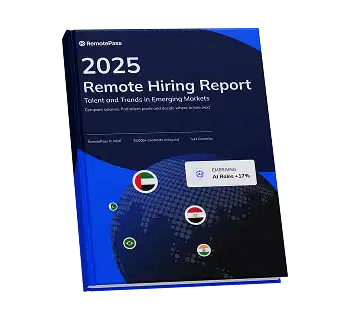
Best EOR for Startups: How to Choose the Right Employer of Record in 2026

Stella Johnson

January 20, 2026

Key Takeaways for Best EOR for Startups

  • There’s no single best Employer of Record for every startup. The right EOR depends on how you’re hiring, where you’re hiring, and how much flexibility you need.
  • Startups should evaluate EOR providers based on pricing transparency, speed to hire, contract flexibility, and quality of support, not enterprise feature sets.
  • Monthly EOR pricing doesn't always reflect true cost. Benefits, setup fees, FX, and offboarding terms matter just as much.
  • “Global coverage” isn’t equal across providers. Depth in specific regions, including MENA, varies widely.
  • Using a scenario-based approach makes it easier to choose the best EOR for your startup without overpaying or overcommitting.

Choose the right Employer of Record for your startup in 2026. Compare costs, flexibility, hiring speed, and the best EORs for scaling.

I recently asked five different AI tools the same question: “On a scale of 1–10, how difficult is it to choose the best Employer of Record (EOR) for a startup?”

Every answer landed between 7 and 8. That’s because, unlike an enterprise, choosing the best Employer of Record (EOR) for a startup comes with a very different set of constraints. 

You don’t have a dedicated legal team, a long planning horizon, or room for pricing surprises and you’re hiring under time pressure, working with a limited runway, and making decisions that need to stay flexible as your plans change. 

A wrong EOR choice would not only slow you down but can lock you into contracts, inflate your burn, or create compliance headaches that are hard to unwind later.

This gets more challenging when most “best EOR” lists don’t reflect how startups actually operate. They focus on broad country coverage and enterprise features, while skipping the questions that matter when you’re early or scaling: How fast can you hire? What will this really cost over the next year? How flexible is the contract if things change?

To help you make the right call, we’ve put together a practical guide to choosing the best EOR for startups. We start with the criteria startups should actually use when evaluating an Employer of Record, then apply that framework to leading EOR providers. 

What Startups Should Consider When Choosing an EOR

Since not all Employer of Record buyers have the same needs, the evaluation framework should be different. Enterprises optimize for scale, process depth, and long-term standardization. Startups prioritize speed, predictable costs, and flexibility.

The criteria below focus on what actually affects outcomes when choosing the best EOR for startups. We’ll use this framework consistently to assess every Employer of Record in this guide.

Transparent Pricing With No Hidden Fees

For startups, pricing predictability matters more than the headline monthly rate. Most EOR pricing starts with a per-employee monthly fee, but that number sometimes doesn't reflect what you’ll actually pay.

Flat pricing is usually easier to forecast than percentage-of-salary models, which can fluctuate as compensation changes.

Beyond the base fee, look closely at setup fees, offboarding costs, currency conversion markups, and add-ons for benefits administration or payroll processing. For example, an EOR advertised at $199 per employee per month may also charge:

  • $100–$200 one-time setup
  • 2–4% FX markup on payroll
  • Separate fees for benefits administration

Over 12 months, that $199 fee can easily turn into $300–$350 per employee per month, which changes your burn rate. If pricing details aren’t clear upfront, give it a solid NO.

Speed to Hire

Speed is often the reason startups choose an Employer of Record instead of handling payroll, contracts, and compliance manually. You could piece together local payroll providers, legal counsel, and internal processes, but doing so slows hiring down and increases risk.

An EOR centralizes those moving parts into a single workflow. Contracts, payroll setup, and compliance checks happen in parallel instead of sequentially, which shortens the path from signed offer to start date or from job done to pay received.

When candidates are juggling multiple offers, this time difference can determine whether you close the hire or not.

That said, hiring speed isn’t only about getting an offer signed. It’s also about how quickly you can:

  • Issue a locally compliant contract
  • Complete onboarding without back-and-forth
  • Run payroll accurately and on time
  • Handle statutory filings and contributions from day one

When evaluating EOR providers for startups, ask for concrete timelines. How long does it take to issue a compliant contract? Who owns onboarding once the offer is signed? What happens if payroll or compliance questions come up mid-process? 

Clear answers here are a strong indicator of whether an EOR will actually help you hire faster or just move the bottleneck elsewhere.

Flexibility 

Startups rarely have fixed hiring plans. You might test a new market, pause hiring, restructure a team, or decide that an Employer of Record is no longer the right setup for a specific country.

That’s why flexibility matters. An EOR contract shouldn’t limit your ability to change direction when business conditions change. 

Month-to-month agreements, clear notice periods, and straightforward offboarding terms reduce the risk of being stuck with the wrong provider or paying for roles you no longer need.

Pay close attention to minimum commitments. Some EORs require annual contracts, minimum headcount, or enforce penalties if you reduce employees early. These terms can significantly increase cost if a market doesn’t perform as expected or hiring plans shift.

It’s also important to separate EOR contract terms from local labor law requirements. In many countries, statutory notice periods, severance obligations, or probation rules apply regardless of the provider you use. 

A reliable Employer of Record will explain those obligations upfront and factor them into offboarding timelines and costs, rather than treating them as surprises later.

When evaluating EOR providers for startups, ask how easy it is to exit, not just how easy it is to onboard. 

Strong Support Without a Dedicated HR Team

Another reason startups hire an Employer of Record is this: they don’t have in-house expertise to manage international employment safely.

In early-stage and bootstrapped teams, every hire is highly scrutinized. Founders often ask whether a role is extremely necessary before approving headcount, which means there’s rarely room for a dedicated HR or compliance hire. 

When you bring on an international employee, the EOR becomes your de facto HR, payroll, and compliance function. That makes support quality critical. You need fast, practical answers when questions come up about contracts, payroll changes, benefits, or local labor requirements. 

Dedicated account managers or clearly assigned points of contact are usually more effective than support models that rely solely on queued requests and asynchronous responses, especially during your first international hires. 

Time zone coverage matters as well. Slow responses can delay payroll, push onboarding past cutoff dates, or create compliance issues when problems need immediate resolution.

All of these to say, evaluate support the same way you evaluate cost. Know who you’ll contact when something breaks, how quickly issues are handled, and what level of guidance is included. 

Geographic Coverage That Matches Your Hiring Plans

Country count alone isn’t a useful metric.You’ll often find EORs advertise coverage in 150+ countries, but that number often mixes owned entities with partner networks. 

Owned entities usually mean more control over compliance, payroll, and benefits while partner-based coverage adds handoffs, which can slow execution and reduce consistency.

Focus on the countries where you actually plan to hire. Depth in two or three markets matters more than broad global coverage you may never use.

This is especially important when hiring in or from MENA and other emerging markets. Some providers list the region but lack operational depth, which can lead to delays, limited benefits options, or unclear guidance on local requirements.

Benefits quality also varies by country and provider. When evaluating EOR providers for startups, prioritize geographic strength that matches your hiring plan. Don’t pay for global reach you don’t need.

Real Total Cost of Ownership

To understand what an EOR will actually cost, you need to calculate total cost of ownership over time, not just compare sticker prices. At a minimum, include:

  • The base monthly EOR fee
  • Statutory benefits and employer contributions, which vary by country
  • Payroll processing and administration
  • Benefits administration fees
  • Currency conversion or FX markups
  • One-time setup and offboarding costs

Here’s how the math often works. An EOR advertised at $199 per employee per month might look like this once required costs are included:

  • $199 base EOR fee
  • $80–$120 in statutory benefits and employer contributions
  • $20–$30 in payroll processing, benefits administration, and FX fees

That puts the realistic monthly cost closer to $300–$350 per employee, or $3,600–$4,200 per year for an employee, before any one-time setup or termination fees.

This matters because EOR costs scale linearly with headcount. Underestimating monthly spend by $100 per employee can affect your burn rate as you add hires. 

When comparing EOR providers for startups, always ask for a country-specific cost breakdown and model costs over 12 months. The best EOR for startups is the one with the most predictable total cost once all required expenses are included.

The 6 Best EORs for Startups

We evaluated six Employer of Record providers against the startup-specific criteria outlined above. Each performs well in different areas, and there’s no single “best” EOR for every startup situation.

1) RemotePass
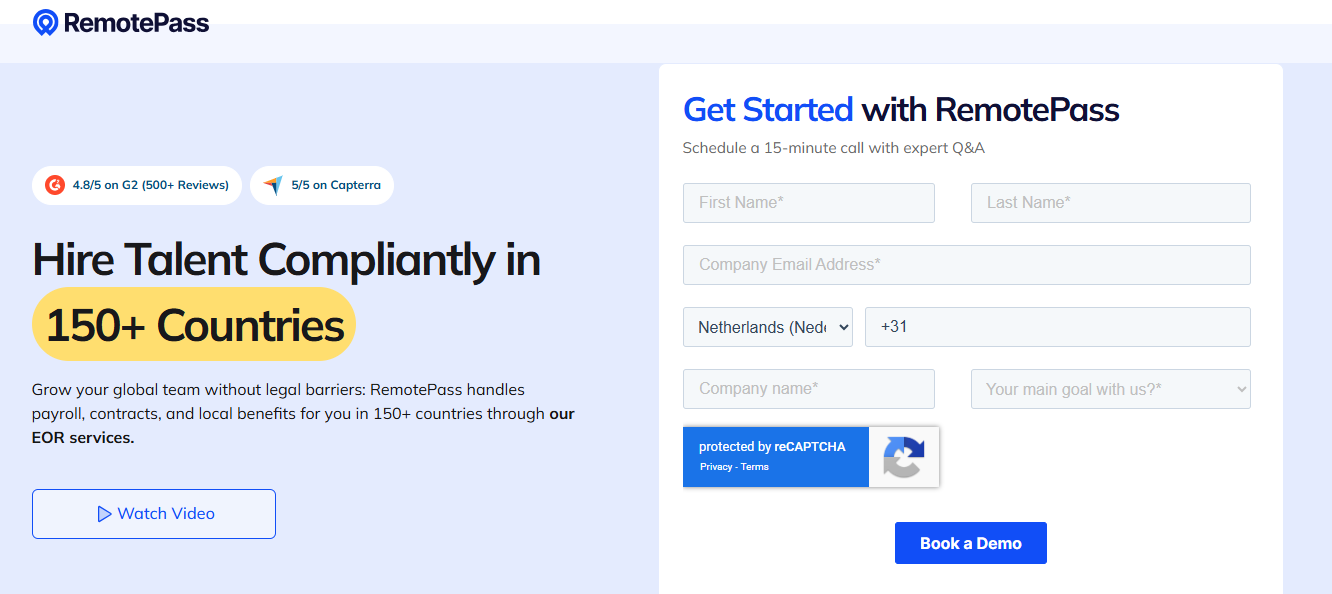
Best EOR for startups RemotePass demo page

RemotePass is a UAE-based Employer of Record with strong MENA expertise, transparent pricing, and a product built for startups and growth-stage companies.

Framework evaluation:

Transparent pricing

RemotePass uses flat, per-employee pricing with clear inclusions. Costs are easier to forecast compared to percentage-based models or providers that gate details behind sales calls.

Pricing begins at $349/mo (including tax) per full time employee and $39/mo for contractors and freelancers.

Speed

Contract generation and onboarding are designed to move quickly once documentation is ready. It takes a few minutes to get an account or contract up and running.

Response times tend to be predictable, especially during payroll and onboarding cycles.

Flexibility

Contracts are startup-friendly, with clear offboarding terms and no aggressive minimum headcount requirements. This works well for teams testing new markets or adjusting hiring plans.

Support

Customers typically work with clearly assigned points of contact rather than fully asynchronous support models. 

Geographic coverage

RemotePass has deep operational strength in MENA, with coverage extending into Europe and other regions. This is a key differentiator for startups hiring in or from the Middle East.

Total cost

Total cost is generally predictable due to flat pricing and fewer add-ons. 

Best for

Startups hiring in MENA, or teams prioritizing pricing transparency, predictable costs, and straightforward contracts.

Book a 15-minute demo and one of our experts will help you figure out if we're a good fit.

2) RemoFirst
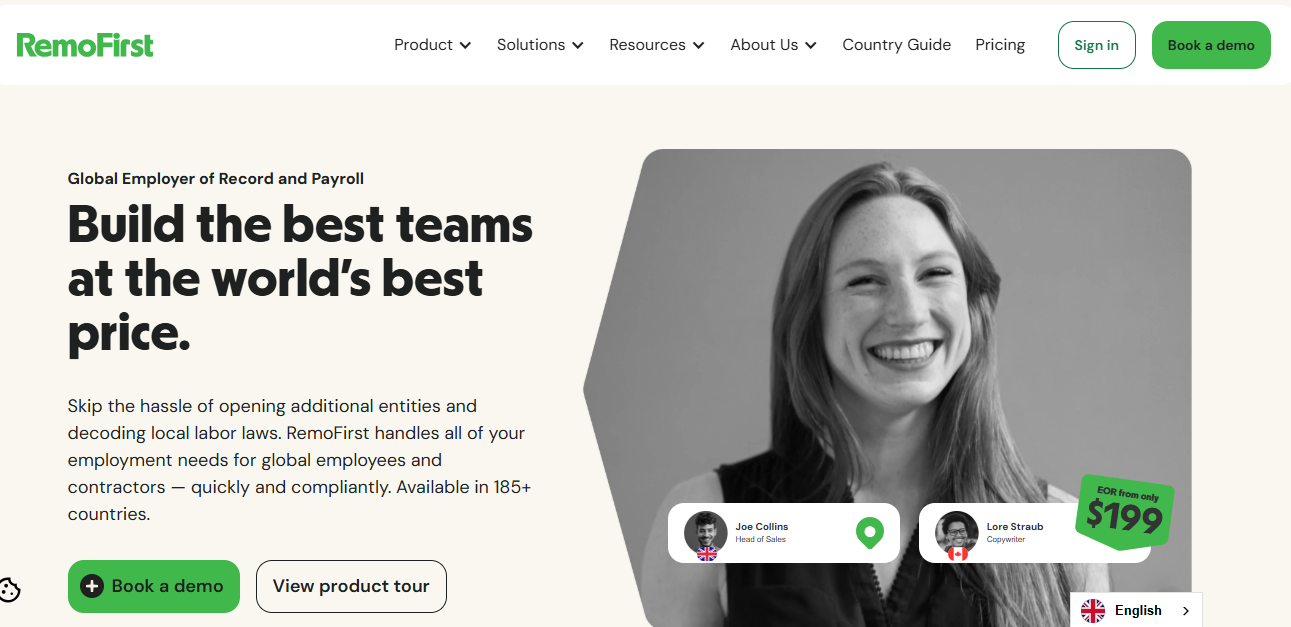
best EOR for startups RemoFirst

RemoFirst positions itself as a budget-friendly EOR with broad global coverage and a more self-serve platform experience.

Framework evaluation:

Transparent pricing

Pricing is generally lower than many competitors, though some services and support levels may incur additional costs. Pricing starts at $199 per employee/month and $25 per contractor/month.

Speed

Onboarding speed is competitive for standard use cases. More complex scenarios may require additional coordination.

Flexibility

RemoFirst is relatively flexible for small teams and early hires, which appeals to bootstrapped startups testing multiple markets.

Support

Support leans more toward asynchronous and self-serve workflows. This can work well for teams comfortable managing details independently.

Geographic coverage

Coverage spans over 185 countries, primarily through partner networks rather than owned entities.

Total cost

Lower base pricing can be attractive, but total cost depends on support needs and add-ons.

Best for

Bootstrapped startups testing multiple countries with one or two hires and simple requirements.

3) Deel
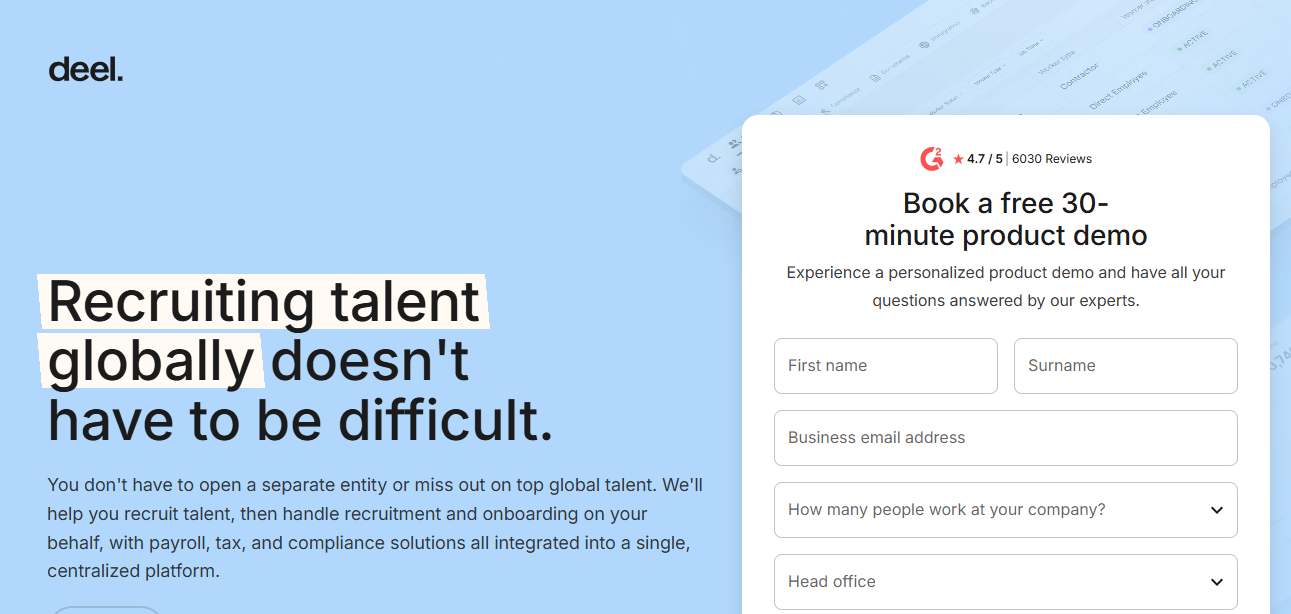
Best EOR for startups Deel

Deel offers a comprehensive platform covering EOR, contractor management, and global payroll, with extensive integrations.

Framework evaluation:

Transparent pricing

Pricing is structured and starts at $599 per employee/ month and $325 per contractor if record /month.

Deel’s pricing can become more complex as services, regions, and headcount scale, with some costs only becoming clear after sales discussions.

Speed

Deel performs well for standardized workflows and teams already using its contractor or payroll products.

Flexibility

The platform supports multiple workforce models, though contracts and processes can feel heavier for very small teams.

Support

Deel's support structure varies by plan and region. Dedicated account management is more common on higher-tier plans, while smaller teams typically rely on shared support workflows.

Total cost

Costs can add up as features, integrations, and additional services are layered on.

Best for

Startups managing a mix of contractors and employees across many countries that want everything in one platform.

4) Remote
Best EOR for startups Remote

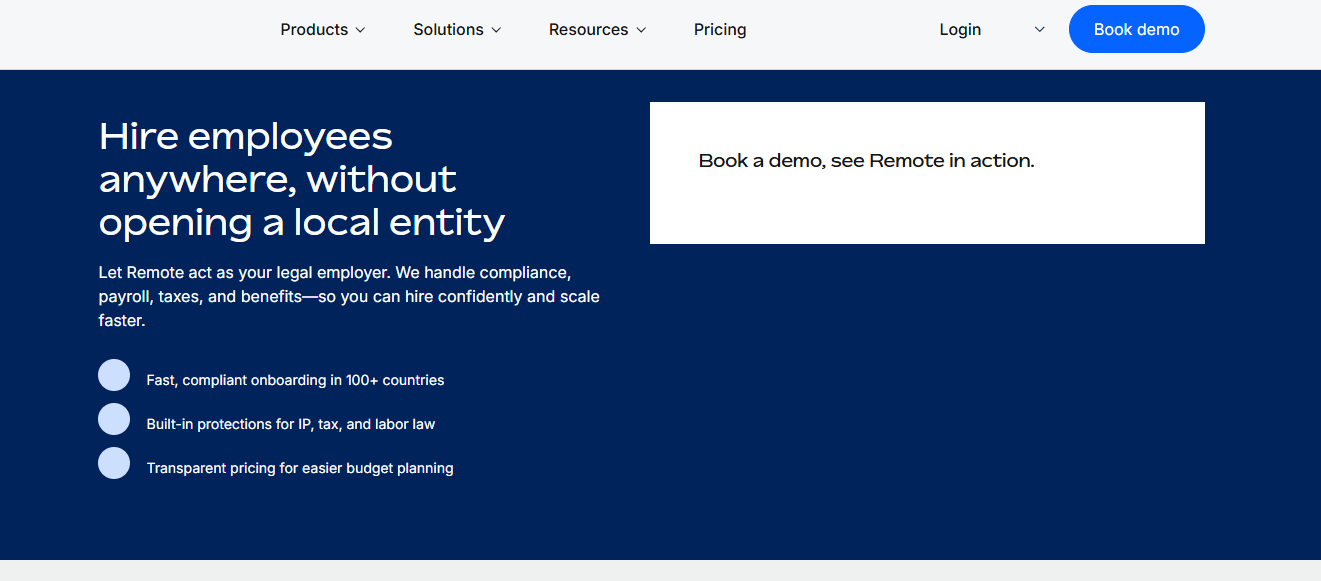
Remote operates through an owned-entity model with a strong emphasis on compliance, IP protection, and employment infrastructure.

Framework evaluation:

Transparent pricing

Remote’s pricing is generally clear and begins at $699 per employee/month and $325 per contractor of record/ month.

Costs are easier to understand upfront, but less flexible for teams trying to optimize spend at very early stages.

Speed

Processes are reliable.

Flexibility

Remote is better suited to predictable hiring plans. It is less ideal for startups that expect frequent changes in headcount, market testing, or short-term hires, as the model prioritizes stability over rapid adjustment.

Support

Users report fast and polite customer support. 

Geographic coverage

Remote has strong coverage (over 100+)  through owned entities in many countries, which reduces reliance on third-party partners and improves compliance reliability.

Total cost

Overall cost is higher, but that cost reflects reduced compliance risk, particularly in countries with strict labor laws or IP considerations.

Best for

Well-funded startups hiring senior, long-term, or IP-sensitive roles where compliance depth and employment protection matter more than speed or cost.

5. Oyster
Best EOR for startups Oyster

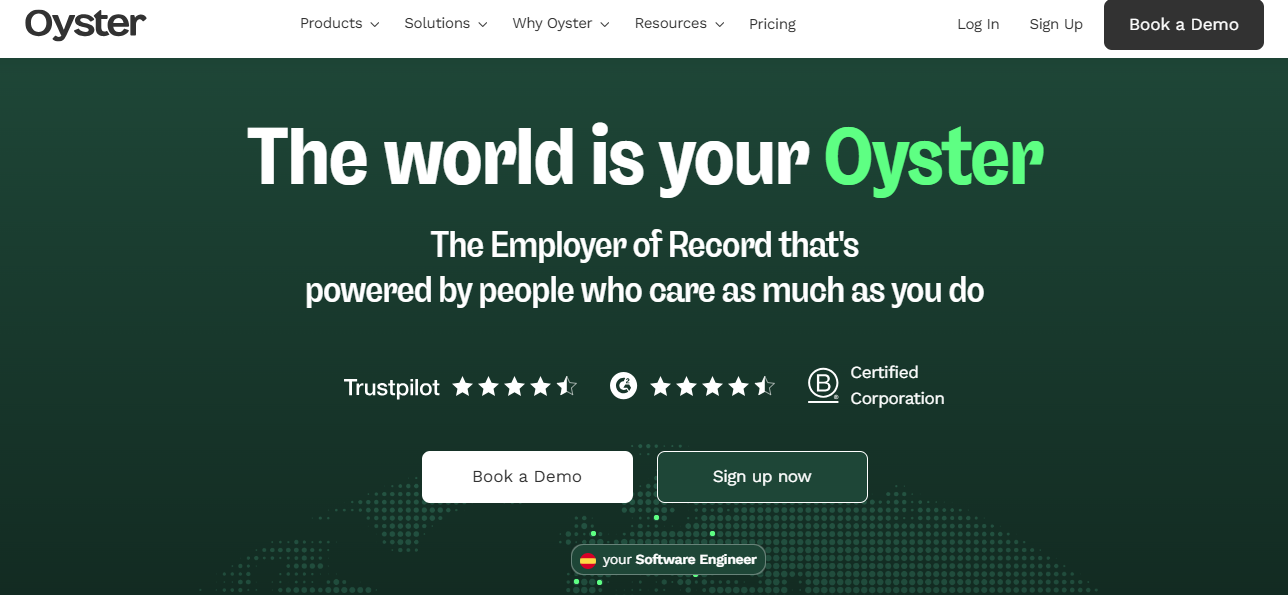
Oyster positions itself as a premium Employer of Record with a strong focus on employee experience, benefits, and guided onboarding. The platform is designed to support companies that are new to international hiring.

Framework evaluation:

Transparent pricing

Pricing is clearly presented but sits at the higher end of the market. It starts at $699 per employee/ month and $29 per contractor/ month.

Speed

Speed is pretty solid. Onboarding takes about  48 hours.

Flexibility

Oyster works best for companies with defined hiring plans and sufficient budget flexibility. 

Support

Support is high-touch, with strong documentation, onboarding guidance, and educational resources. This level of support is valuable for teams without prior EOR experience.

Geographic coverage

Oyster offers broad coverage (over 180 countries), primarily through partner networks rather than owned entities. Coverage breadth is strong, though depth varies by country.

Total cost

Total cost is typically higher once benefits and premium support are included.

Best for

Series A+ startups hiring internationally for the first time that want extensive guidance and a polished employee experience.

6) Multiplier
Best EOR for startups Multiplier

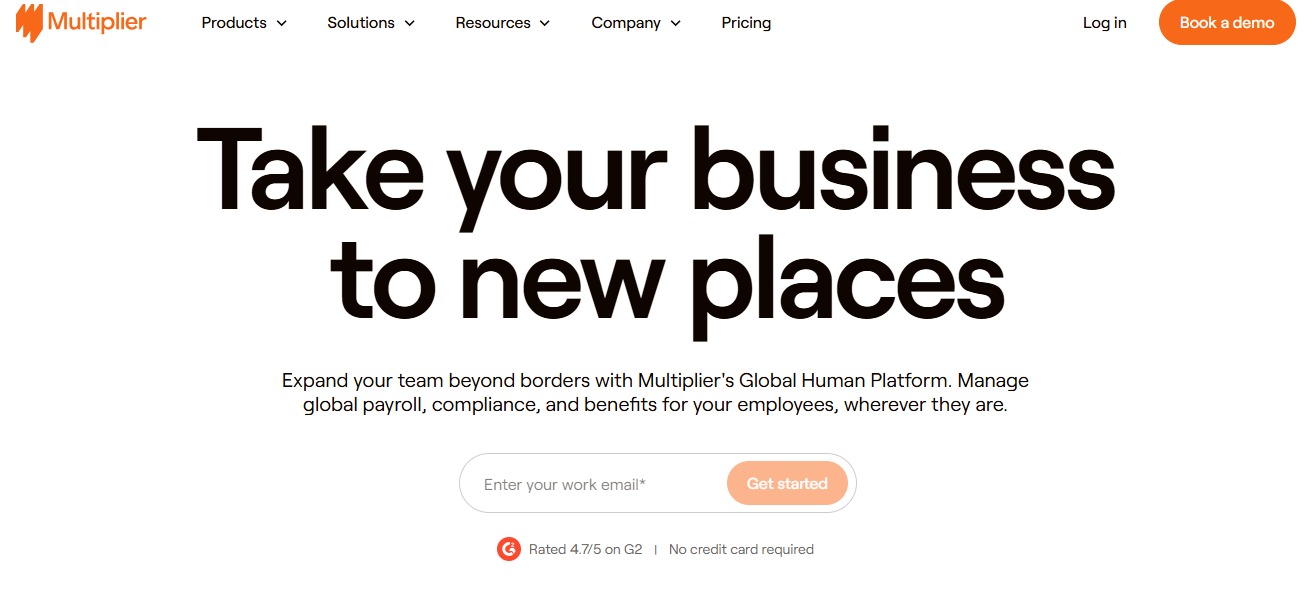
Multiplier offers a modern EOR platform with a focus on speed, usability, and mid-range pricing. It’s designed for startups that want to move quickly without paying enterprise-level costs.

Framework evaluation:

Transparent pricing

Pricing is generally straightforward, with fewer hidden layers than enterprise platforms. It starts at $400 per employee/ month and $40 per employee/ month for contractors.

Speed

Multiplier is known for fast setup and efficient workflows in standard hiring scenarios. 

Flexibility

Flexibility is reasonable for growing startups, with terms that support ongoing hiring across multiple countries. 

Support

Support is available 24/5. This balance works well for teams that want help when needed but don’t require constant hand-holding.

Geographic coverage

Multiplier offers good coverage across multiple regions (over 150+), including several emerging markets, though depth can vary by country.

Total cost

Total cost is usually predictable because pricing is transparent, but add-ons can increase spend depending on your setup.

Best for

Startups that prioritize fast execution, a clean platform experience, and predictable mid-range costs.

Quick Decision Framework: Which EOR Fits Your Startup Situation?

The goal isn’t to find the “best” Employer of Record in the abstract. It’s to identify the EOR that fits your current constraints, priorities, and risk tolerance. Use the scenarios below to narrow your shortlist based on how you’re hiring. 

If You’re Hiring Your First 1–2 International Employees

When you’re making your first international hires, clarity and support matter more than advanced features.

You’ll want transparent pricing, clear guidance on contracts and compliance, and responsive support when questions come up. Over-optimizing for global reach or complex tooling at this stage usually adds cost without much benefit.

Consider: RemotePass, Oyster

These providers work well when you want predictable costs and hands-on guidance without needing to manage details yourself.

If You’re Testing a New Market With 3–5 Hires

Market testing requires flexibility. You may need to pause hiring, adjust roles, or exit a country if results don’t justify further investment.

Prioritize EORs with flexible contracts, clear offboarding terms, and the ability to move quickly without long-term commitments. Speed and adaptability matter more here than the lowest possible price.

Consider: RemotePass, Multiplier, RemoFirst

These options balance execution speed with reasonable flexibility for changing plans.

If You’re Scaling to 10+ Employees in One Country

At this stage, cost efficiency and compliance depth start to matter more than experimentation. You’ll want to evaluate whether an Employer of Record still makes sense or if setting up a local entity is more cost-effective long term.

If you continue with an EOR, prioritize providers with strong country-specific expertise and predictable total cost at scale.

Consider: Remote, Deel

These providers are better suited to stable, long-term hiring in a single market, especially where compliance or IP protection is critical.

If You’re Hiring Across MENA Markets

Generic global coverage isn’t enough when hiring in or from MENA. Local expertise affects contract structure, payroll execution, benefits quality, and compliance reliability.

Providers without operational depth in the region may introduce delays or inconsistent guidance.

Consider: RemotePass

RemotePass stands out here due to its MENA focus and regional operational strength.

If Budget Is Your Primary Constraint

When budget is tight, you’ll need to accept trade-offs. Lower-cost EORs can work well for simple setups and small teams, but they often rely more on self-serve workflows and slower support models. 

Make sure you’re comfortable managing details internally before prioritizing price alone.

Consider: RemoFirst

This option can make sense for lean teams that want to minimize cost and are comfortable with less hands-on support.

This framework should help you narrow your options to two or three EOR providers before booking demos. Once you know which scenario best fits your situation, the right choice usually becomes clear.

Conclusion

There’s no single best Employer of Record for every startup. The right choice depends on how fast you need to hire, where you’re hiring, how much flexibility you need, and what level of risk you’re willing to manage.

Use the framework in this guide to narrow your shortlist, compare total cost instead of sticker price, and focus on providers that match your hiring plan, not generic rankings.  Once you’ve identified two or three options, the next step is to book demos and validate assumptions around pricing, support, and regional coverage.

If you’re hiring internationally and want predictable costs, flexible contracts, and strong MENA expertise, book a demo with RemotePass to see if it fits your startup’s needs.

FAQs About the Best EOR for Startups

How do I know if I need an EOR or can just hire contractors?

If the role is ongoing, full-time, and core to your business, an Employer of Record is usually the safer option. Contractors work best for short-term or project-based roles, but they carry misclassification risk in many countries. An EOR handles compliance, payroll, and local employment requirements so you don’t have to manage that risk yourself.

Is an EOR worth it for just one or two hires?

Yes, in many cases. For one or two international employees, an EOR is often more cost-effective and lower risk than setting up a local entity or managing compliance manually. The key is choosing a provider with flexible contracts and transparent pricing so costs stay predictable.

What’s the real cost beyond the monthly EOR fee?

The base fee is only part of the cost. You should also account for statutory benefits, payroll processing, benefits administration, currency conversion, and any setup or offboarding fees. 

Which EOR providers actually have strong MENA expertise?

Many EORs list MENA countries as part of their global coverage, but operational depth varies. Look for providers with established entities or strong local partners in the region, clear guidance on local labor laws, and benefits tailored to MENA markets. Regional expertise matters more than headline country count.

Table of Contents

Need help onboarding, hiring, and paying global teams?

15 min demo15 min demo

I recently asked five different AI tools the same question: “On a scale of 1–10, how difficult is it to choose the best Employer of Record (EOR) for a startup?”

Every answer landed between 7 and 8. That’s because, unlike an enterprise, choosing the best Employer of Record (EOR) for a startup comes with a very different set of constraints. 

You don’t have a dedicated legal team, a long planning horizon, or room for pricing surprises and you’re hiring under time pressure, working with a limited runway, and making decisions that need to stay flexible as your plans change. 

A wrong EOR choice would not only slow you down but can lock you into contracts, inflate your burn, or create compliance headaches that are hard to unwind later.

This gets more challenging when most “best EOR” lists don’t reflect how startups actually operate. They focus on broad country coverage and enterprise features, while skipping the questions that matter when you’re early or scaling: How fast can you hire? What will this really cost over the next year? How flexible is the contract if things change?

To help you make the right call, we’ve put together a practical guide to choosing the best EOR for startups. We start with the criteria startups should actually use when evaluating an Employer of Record, then apply that framework to leading EOR providers. 

What Startups Should Consider When Choosing an EOR

Since not all Employer of Record buyers have the same needs, the evaluation framework should be different. Enterprises optimize for scale, process depth, and long-term standardization. Startups prioritize speed, predictable costs, and flexibility.

The criteria below focus on what actually affects outcomes when choosing the best EOR for startups. We’ll use this framework consistently to assess every Employer of Record in this guide.

Transparent Pricing With No Hidden Fees

For startups, pricing predictability matters more than the headline monthly rate. Most EOR pricing starts with a per-employee monthly fee, but that number sometimes doesn't reflect what you’ll actually pay.

Flat pricing is usually easier to forecast than percentage-of-salary models, which can fluctuate as compensation changes.

Beyond the base fee, look closely at setup fees, offboarding costs, currency conversion markups, and add-ons for benefits administration or payroll processing. For example, an EOR advertised at $199 per employee per month may also charge:

  • $100–$200 one-time setup
  • 2–4% FX markup on payroll
  • Separate fees for benefits administration

Over 12 months, that $199 fee can easily turn into $300–$350 per employee per month, which changes your burn rate. If pricing details aren’t clear upfront, give it a solid NO.

Speed to Hire

Speed is often the reason startups choose an Employer of Record instead of handling payroll, contracts, and compliance manually. You could piece together local payroll providers, legal counsel, and internal processes, but doing so slows hiring down and increases risk.

An EOR centralizes those moving parts into a single workflow. Contracts, payroll setup, and compliance checks happen in parallel instead of sequentially, which shortens the path from signed offer to start date or from job done to pay received.

When candidates are juggling multiple offers, this time difference can determine whether you close the hire or not.

That said, hiring speed isn’t only about getting an offer signed. It’s also about how quickly you can:

  • Issue a locally compliant contract
  • Complete onboarding without back-and-forth
  • Run payroll accurately and on time
  • Handle statutory filings and contributions from day one

When evaluating EOR providers for startups, ask for concrete timelines. How long does it take to issue a compliant contract? Who owns onboarding once the offer is signed? What happens if payroll or compliance questions come up mid-process? 

Clear answers here are a strong indicator of whether an EOR will actually help you hire faster or just move the bottleneck elsewhere.

Flexibility 

Startups rarely have fixed hiring plans. You might test a new market, pause hiring, restructure a team, or decide that an Employer of Record is no longer the right setup for a specific country.

That’s why flexibility matters. An EOR contract shouldn’t limit your ability to change direction when business conditions change. 

Month-to-month agreements, clear notice periods, and straightforward offboarding terms reduce the risk of being stuck with the wrong provider or paying for roles you no longer need.

Pay close attention to minimum commitments. Some EORs require annual contracts, minimum headcount, or enforce penalties if you reduce employees early. These terms can significantly increase cost if a market doesn’t perform as expected or hiring plans shift.

It’s also important to separate EOR contract terms from local labor law requirements. In many countries, statutory notice periods, severance obligations, or probation rules apply regardless of the provider you use. 

A reliable Employer of Record will explain those obligations upfront and factor them into offboarding timelines and costs, rather than treating them as surprises later.

When evaluating EOR providers for startups, ask how easy it is to exit, not just how easy it is to onboard. 

Strong Support Without a Dedicated HR Team

Another reason startups hire an Employer of Record is this: they don’t have in-house expertise to manage international employment safely.

In early-stage and bootstrapped teams, every hire is highly scrutinized. Founders often ask whether a role is extremely necessary before approving headcount, which means there’s rarely room for a dedicated HR or compliance hire. 

When you bring on an international employee, the EOR becomes your de facto HR, payroll, and compliance function. That makes support quality critical. You need fast, practical answers when questions come up about contracts, payroll changes, benefits, or local labor requirements. 

Dedicated account managers or clearly assigned points of contact are usually more effective than support models that rely solely on queued requests and asynchronous responses, especially during your first international hires. 

Time zone coverage matters as well. Slow responses can delay payroll, push onboarding past cutoff dates, or create compliance issues when problems need immediate resolution.

All of these to say, evaluate support the same way you evaluate cost. Know who you’ll contact when something breaks, how quickly issues are handled, and what level of guidance is included. 

Geographic Coverage That Matches Your Hiring Plans

Country count alone isn’t a useful metric.You’ll often find EORs advertise coverage in 150+ countries, but that number often mixes owned entities with partner networks. 

Owned entities usually mean more control over compliance, payroll, and benefits while partner-based coverage adds handoffs, which can slow execution and reduce consistency.

Focus on the countries where you actually plan to hire. Depth in two or three markets matters more than broad global coverage you may never use.

This is especially important when hiring in or from MENA and other emerging markets. Some providers list the region but lack operational depth, which can lead to delays, limited benefits options, or unclear guidance on local requirements.

Benefits quality also varies by country and provider. When evaluating EOR providers for startups, prioritize geographic strength that matches your hiring plan. Don’t pay for global reach you don’t need.

Real Total Cost of Ownership

To understand what an EOR will actually cost, you need to calculate total cost of ownership over time, not just compare sticker prices. At a minimum, include:

  • The base monthly EOR fee
  • Statutory benefits and employer contributions, which vary by country
  • Payroll processing and administration
  • Benefits administration fees
  • Currency conversion or FX markups
  • One-time setup and offboarding costs

Here’s how the math often works. An EOR advertised at $199 per employee per month might look like this once required costs are included:

  • $199 base EOR fee
  • $80–$120 in statutory benefits and employer contributions
  • $20–$30 in payroll processing, benefits administration, and FX fees

That puts the realistic monthly cost closer to $300–$350 per employee, or $3,600–$4,200 per year for an employee, before any one-time setup or termination fees.

This matters because EOR costs scale linearly with headcount. Underestimating monthly spend by $100 per employee can affect your burn rate as you add hires. 

When comparing EOR providers for startups, always ask for a country-specific cost breakdown and model costs over 12 months. The best EOR for startups is the one with the most predictable total cost once all required expenses are included.

The 6 Best EORs for Startups

We evaluated six Employer of Record providers against the startup-specific criteria outlined above. Each performs well in different areas, and there’s no single “best” EOR for every startup situation.

1) RemotePass

Best EOR for startups RemotePass demo page

RemotePass is a UAE-based Employer of Record with strong MENA expertise, transparent pricing, and a product built for startups and growth-stage companies.

Framework evaluation:

Transparent pricing

RemotePass uses flat, per-employee pricing with clear inclusions. Costs are easier to forecast compared to percentage-based models or providers that gate details behind sales calls.

Pricing begins at $349/mo (including tax) per full time employee and $39/mo for contractors and freelancers.

Speed

Contract generation and onboarding are designed to move quickly once documentation is ready. It takes a few minutes to get an account or contract up and running.

Response times tend to be predictable, especially during payroll and onboarding cycles.

Flexibility

Contracts are startup-friendly, with clear offboarding terms and no aggressive minimum headcount requirements. This works well for teams testing new markets or adjusting hiring plans.

Support

Customers typically work with clearly assigned points of contact rather than fully asynchronous support models. 

Geographic coverage

RemotePass has deep operational strength in MENA, with coverage extending into Europe and other regions. This is a key differentiator for startups hiring in or from the Middle East.

Total cost

Total cost is generally predictable due to flat pricing and fewer add-ons. 

Best for

Startups hiring in MENA, or teams prioritizing pricing transparency, predictable costs, and straightforward contracts.

Book a 15-minute demo and one of our experts will help you figure out if we're a good fit.

2) RemoFirst

best EOR for startups RemoFirst

RemoFirst positions itself as a budget-friendly EOR with broad global coverage and a more self-serve platform experience.

Framework evaluation:

Transparent pricing

Pricing is generally lower than many competitors, though some services and support levels may incur additional costs. Pricing starts at $199 per employee/month and $25 per contractor/month.

Speed

Onboarding speed is competitive for standard use cases. More complex scenarios may require additional coordination.

Flexibility

RemoFirst is relatively flexible for small teams and early hires, which appeals to bootstrapped startups testing multiple markets.

Support

Support leans more toward asynchronous and self-serve workflows. This can work well for teams comfortable managing details independently.

Geographic coverage

Coverage spans over 185 countries, primarily through partner networks rather than owned entities.

Total cost

Lower base pricing can be attractive, but total cost depends on support needs and add-ons.

Best for

Bootstrapped startups testing multiple countries with one or two hires and simple requirements.

3) Deel

Best EOR for startups Deel

Deel offers a comprehensive platform covering EOR, contractor management, and global payroll, with extensive integrations.

Framework evaluation:

Transparent pricing

Pricing is structured and starts at $599 per employee/ month and $325 per contractor if record /month.

Deel’s pricing can become more complex as services, regions, and headcount scale, with some costs only becoming clear after sales discussions.

Speed

Deel performs well for standardized workflows and teams already using its contractor or payroll products.

Flexibility

The platform supports multiple workforce models, though contracts and processes can feel heavier for very small teams.

Support

Deel's support structure varies by plan and region. Dedicated account management is more common on higher-tier plans, while smaller teams typically rely on shared support workflows.

Total cost

Costs can add up as features, integrations, and additional services are layered on.

Best for

Startups managing a mix of contractors and employees across many countries that want everything in one platform.

4) Remote

Best EOR for startups Remote

Remote operates through an owned-entity model with a strong emphasis on compliance, IP protection, and employment infrastructure.

Framework evaluation:

Transparent pricing

Remote’s pricing is generally clear and begins at $699 per employee/month and $325 per contractor of record/ month.

Costs are easier to understand upfront, but less flexible for teams trying to optimize spend at very early stages.

Speed

Processes are reliable.

Flexibility

Remote is better suited to predictable hiring plans. It is less ideal for startups that expect frequent changes in headcount, market testing, or short-term hires, as the model prioritizes stability over rapid adjustment.

Support

Users report fast and polite customer support. 

Geographic coverage

Remote has strong coverage (over 100+)  through owned entities in many countries, which reduces reliance on third-party partners and improves compliance reliability.

Total cost

Overall cost is higher, but that cost reflects reduced compliance risk, particularly in countries with strict labor laws or IP considerations.

Best for

Well-funded startups hiring senior, long-term, or IP-sensitive roles where compliance depth and employment protection matter more than speed or cost.

5. Oyster

Best EOR for startups Oyster

Oyster positions itself as a premium Employer of Record with a strong focus on employee experience, benefits, and guided onboarding. The platform is designed to support companies that are new to international hiring.

Framework evaluation:

Transparent pricing

Pricing is clearly presented but sits at the higher end of the market. It starts at $699 per employee/ month and $29 per contractor/ month.

Speed

Speed is pretty solid. Onboarding takes about  48 hours.

Flexibility

Oyster works best for companies with defined hiring plans and sufficient budget flexibility. 

Support

Support is high-touch, with strong documentation, onboarding guidance, and educational resources. This level of support is valuable for teams without prior EOR experience.

Geographic coverage

Oyster offers broad coverage (over 180 countries), primarily through partner networks rather than owned entities. Coverage breadth is strong, though depth varies by country.

Total cost

Total cost is typically higher once benefits and premium support are included.

Best for

Series A+ startups hiring internationally for the first time that want extensive guidance and a polished employee experience.

6) Multiplier

Best EOR for startups Multiplier

Multiplier offers a modern EOR platform with a focus on speed, usability, and mid-range pricing. It’s designed for startups that want to move quickly without paying enterprise-level costs.

Framework evaluation:

Transparent pricing

Pricing is generally straightforward, with fewer hidden layers than enterprise platforms. It starts at $400 per employee/ month and $40 per employee/ month for contractors.

Speed

Multiplier is known for fast setup and efficient workflows in standard hiring scenarios. 

Flexibility

Flexibility is reasonable for growing startups, with terms that support ongoing hiring across multiple countries. 

Support

Support is available 24/5. This balance works well for teams that want help when needed but don’t require constant hand-holding.

Geographic coverage

Multiplier offers good coverage across multiple regions (over 150+), including several emerging markets, though depth can vary by country.

Total cost

Total cost is usually predictable because pricing is transparent, but add-ons can increase spend depending on your setup.

Best for

Startups that prioritize fast execution, a clean platform experience, and predictable mid-range costs.

Quick Decision Framework: Which EOR Fits Your Startup Situation?

The goal isn’t to find the “best” Employer of Record in the abstract. It’s to identify the EOR that fits your current constraints, priorities, and risk tolerance. Use the scenarios below to narrow your shortlist based on how you’re hiring. 

If You’re Hiring Your First 1–2 International Employees

When you’re making your first international hires, clarity and support matter more than advanced features.

You’ll want transparent pricing, clear guidance on contracts and compliance, and responsive support when questions come up. Over-optimizing for global reach or complex tooling at this stage usually adds cost without much benefit.

Consider: RemotePass, Oyster

These providers work well when you want predictable costs and hands-on guidance without needing to manage details yourself.

If You’re Testing a New Market With 3–5 Hires

Market testing requires flexibility. You may need to pause hiring, adjust roles, or exit a country if results don’t justify further investment.

Prioritize EORs with flexible contracts, clear offboarding terms, and the ability to move quickly without long-term commitments. Speed and adaptability matter more here than the lowest possible price.

Consider: RemotePass, Multiplier, RemoFirst

These options balance execution speed with reasonable flexibility for changing plans.

If You’re Scaling to 10+ Employees in One Country

At this stage, cost efficiency and compliance depth start to matter more than experimentation. You’ll want to evaluate whether an Employer of Record still makes sense or if setting up a local entity is more cost-effective long term.

If you continue with an EOR, prioritize providers with strong country-specific expertise and predictable total cost at scale.

Consider: Remote, Deel

These providers are better suited to stable, long-term hiring in a single market, especially where compliance or IP protection is critical.

If You’re Hiring Across MENA Markets

Generic global coverage isn’t enough when hiring in or from MENA. Local expertise affects contract structure, payroll execution, benefits quality, and compliance reliability.

Providers without operational depth in the region may introduce delays or inconsistent guidance.

Consider: RemotePass

RemotePass stands out here due to its MENA focus and regional operational strength.

If Budget Is Your Primary Constraint

When budget is tight, you’ll need to accept trade-offs. Lower-cost EORs can work well for simple setups and small teams, but they often rely more on self-serve workflows and slower support models. 

Make sure you’re comfortable managing details internally before prioritizing price alone.

Consider: RemoFirst

This option can make sense for lean teams that want to minimize cost and are comfortable with less hands-on support.

This framework should help you narrow your options to two or three EOR providers before booking demos. Once you know which scenario best fits your situation, the right choice usually becomes clear.

Conclusion

There’s no single best Employer of Record for every startup. The right choice depends on how fast you need to hire, where you’re hiring, how much flexibility you need, and what level of risk you’re willing to manage.

Use the framework in this guide to narrow your shortlist, compare total cost instead of sticker price, and focus on providers that match your hiring plan, not generic rankings.  Once you’ve identified two or three options, the next step is to book demos and validate assumptions around pricing, support, and regional coverage.

If you’re hiring internationally and want predictable costs, flexible contracts, and strong MENA expertise, book a demo with RemotePass to see if it fits your startup’s needs.

FAQs About the Best EOR for Startups

How do I know if I need an EOR or can just hire contractors?

If the role is ongoing, full-time, and core to your business, an Employer of Record is usually the safer option. Contractors work best for short-term or project-based roles, but they carry misclassification risk in many countries. An EOR handles compliance, payroll, and local employment requirements so you don’t have to manage that risk yourself.

Is an EOR worth it for just one or two hires?

Yes, in many cases. For one or two international employees, an EOR is often more cost-effective and lower risk than setting up a local entity or managing compliance manually. The key is choosing a provider with flexible contracts and transparent pricing so costs stay predictable.

What’s the real cost beyond the monthly EOR fee?

The base fee is only part of the cost. You should also account for statutory benefits, payroll processing, benefits administration, currency conversion, and any setup or offboarding fees. 

Which EOR providers actually have strong MENA expertise?

Many EORs list MENA countries as part of their global coverage, but operational depth varies. Look for providers with established entities or strong local partners in the region, clear guidance on local labor laws, and benefits tailored to MENA markets. Regional expertise matters more than headline country count.

Payment Options

Choose from 100+ currencies and 7 payment options, including Bank account, Wise, PayPal, Payoneer and more.

Health Coverage

Access health insurance plan for you and your dependents, regardless of your location, with monthly installments.

RemotePass Card

Receive payments in USD, hold funds indefinitely, and enjoy global offline and online spending.

All-in-one Super App

Manage contracts, cards, invoices, expenses, and time-off conveniently through a single app.

Get Started

Transactions

What makes us different

Sagittis scelerisque nulla cursus in enim consectetur quam. Dictum urna sed consectetur neque tristique pellentesque. Blandit amet, sed aenean erat arcu morbi. Cursus faucibus nunc nisl netus morbi vel porttitor vitae ut. Amet vitae fames senectus vitae.

Sagittis scelerisque nulla cursus in enim consectetur quam. Dictum urna sed consectetur neque tristique pellentesque. Blandit amet, sed aenean erat arcu morbi. Cursus faucibus nunc nisl netus morbi vel porttitor vitae ut. Amet vitae fames senectus vitae.

Sagittis scelerisque nulla cursus in enim consectetur quam. Dictum urna sed consectetur neque tristique pellentesque. Blandit amet, sed aenean erat arcu morbi. Cursus faucibus nunc nisl netus morbi vel porttitor vitae ut. Amet vitae fames senectus vitae.

We’re here to help

Sagittis scelerisque nulla cursus in enim consectetur quam. Dictum urna sed consectetur neque tristique pellentesque. Blandit amet, sed aenean erat arcu morbi. Cursus faucibus nunc nisl netus morbi vel porttitor vitae ut. Amet vitae fames senectus vitae.

Copied!

Best EOR for Startups: How to Choose the Right Employer of Record in 2026

Stella Johnson

January 20, 2026

Key Takeaways for Best EOR for Startups

  • There’s no single best Employer of Record for every startup. The right EOR depends on how you’re hiring, where you’re hiring, and how much flexibility you need.
  • Startups should evaluate EOR providers based on pricing transparency, speed to hire, contract flexibility, and quality of support, not enterprise feature sets.
  • Monthly EOR pricing doesn't always reflect true cost. Benefits, setup fees, FX, and offboarding terms matter just as much.
  • “Global coverage” isn’t equal across providers. Depth in specific regions, including MENA, varies widely.
  • Using a scenario-based approach makes it easier to choose the best EOR for your startup without overpaying or overcommitting.

Choose the right Employer of Record for your startup in 2026. Compare costs, flexibility, hiring speed, and the best EORs for scaling.

I recently asked five different AI tools the same question: “On a scale of 1–10, how difficult is it to choose the best Employer of Record (EOR) for a startup?”

Every answer landed between 7 and 8. That’s because, unlike an enterprise, choosing the best Employer of Record (EOR) for a startup comes with a very different set of constraints. 

You don’t have a dedicated legal team, a long planning horizon, or room for pricing surprises and you’re hiring under time pressure, working with a limited runway, and making decisions that need to stay flexible as your plans change. 

A wrong EOR choice would not only slow you down but can lock you into contracts, inflate your burn, or create compliance headaches that are hard to unwind later.

This gets more challenging when most “best EOR” lists don’t reflect how startups actually operate. They focus on broad country coverage and enterprise features, while skipping the questions that matter when you’re early or scaling: How fast can you hire? What will this really cost over the next year? How flexible is the contract if things change?

To help you make the right call, we’ve put together a practical guide to choosing the best EOR for startups. We start with the criteria startups should actually use when evaluating an Employer of Record, then apply that framework to leading EOR providers. 

What Startups Should Consider When Choosing an EOR

Since not all Employer of Record buyers have the same needs, the evaluation framework should be different. Enterprises optimize for scale, process depth, and long-term standardization. Startups prioritize speed, predictable costs, and flexibility.

The criteria below focus on what actually affects outcomes when choosing the best EOR for startups. We’ll use this framework consistently to assess every Employer of Record in this guide.

Transparent Pricing With No Hidden Fees

For startups, pricing predictability matters more than the headline monthly rate. Most EOR pricing starts with a per-employee monthly fee, but that number sometimes doesn't reflect what you’ll actually pay.

Flat pricing is usually easier to forecast than percentage-of-salary models, which can fluctuate as compensation changes.

Beyond the base fee, look closely at setup fees, offboarding costs, currency conversion markups, and add-ons for benefits administration or payroll processing. For example, an EOR advertised at $199 per employee per month may also charge:

  • $100–$200 one-time setup
  • 2–4% FX markup on payroll
  • Separate fees for benefits administration

Over 12 months, that $199 fee can easily turn into $300–$350 per employee per month, which changes your burn rate. If pricing details aren’t clear upfront, give it a solid NO.

Speed to Hire

Speed is often the reason startups choose an Employer of Record instead of handling payroll, contracts, and compliance manually. You could piece together local payroll providers, legal counsel, and internal processes, but doing so slows hiring down and increases risk.

An EOR centralizes those moving parts into a single workflow. Contracts, payroll setup, and compliance checks happen in parallel instead of sequentially, which shortens the path from signed offer to start date or from job done to pay received.

When candidates are juggling multiple offers, this time difference can determine whether you close the hire or not.

That said, hiring speed isn’t only about getting an offer signed. It’s also about how quickly you can:

  • Issue a locally compliant contract
  • Complete onboarding without back-and-forth
  • Run payroll accurately and on time
  • Handle statutory filings and contributions from day one

When evaluating EOR providers for startups, ask for concrete timelines. How long does it take to issue a compliant contract? Who owns onboarding once the offer is signed? What happens if payroll or compliance questions come up mid-process? 

Clear answers here are a strong indicator of whether an EOR will actually help you hire faster or just move the bottleneck elsewhere.

Flexibility 

Startups rarely have fixed hiring plans. You might test a new market, pause hiring, restructure a team, or decide that an Employer of Record is no longer the right setup for a specific country.

That’s why flexibility matters. An EOR contract shouldn’t limit your ability to change direction when business conditions change. 

Month-to-month agreements, clear notice periods, and straightforward offboarding terms reduce the risk of being stuck with the wrong provider or paying for roles you no longer need.

Pay close attention to minimum commitments. Some EORs require annual contracts, minimum headcount, or enforce penalties if you reduce employees early. These terms can significantly increase cost if a market doesn’t perform as expected or hiring plans shift.

It’s also important to separate EOR contract terms from local labor law requirements. In many countries, statutory notice periods, severance obligations, or probation rules apply regardless of the provider you use. 

A reliable Employer of Record will explain those obligations upfront and factor them into offboarding timelines and costs, rather than treating them as surprises later.

When evaluating EOR providers for startups, ask how easy it is to exit, not just how easy it is to onboard. 

Strong Support Without a Dedicated HR Team

Another reason startups hire an Employer of Record is this: they don’t have in-house expertise to manage international employment safely.

In early-stage and bootstrapped teams, every hire is highly scrutinized. Founders often ask whether a role is extremely necessary before approving headcount, which means there’s rarely room for a dedicated HR or compliance hire. 

When you bring on an international employee, the EOR becomes your de facto HR, payroll, and compliance function. That makes support quality critical. You need fast, practical answers when questions come up about contracts, payroll changes, benefits, or local labor requirements. 

Dedicated account managers or clearly assigned points of contact are usually more effective than support models that rely solely on queued requests and asynchronous responses, especially during your first international hires. 

Time zone coverage matters as well. Slow responses can delay payroll, push onboarding past cutoff dates, or create compliance issues when problems need immediate resolution.

All of these to say, evaluate support the same way you evaluate cost. Know who you’ll contact when something breaks, how quickly issues are handled, and what level of guidance is included. 

Geographic Coverage That Matches Your Hiring Plans

Country count alone isn’t a useful metric.You’ll often find EORs advertise coverage in 150+ countries, but that number often mixes owned entities with partner networks. 

Owned entities usually mean more control over compliance, payroll, and benefits while partner-based coverage adds handoffs, which can slow execution and reduce consistency.

Focus on the countries where you actually plan to hire. Depth in two or three markets matters more than broad global coverage you may never use.

This is especially important when hiring in or from MENA and other emerging markets. Some providers list the region but lack operational depth, which can lead to delays, limited benefits options, or unclear guidance on local requirements.

Benefits quality also varies by country and provider. When evaluating EOR providers for startups, prioritize geographic strength that matches your hiring plan. Don’t pay for global reach you don’t need.

Real Total Cost of Ownership

To understand what an EOR will actually cost, you need to calculate total cost of ownership over time, not just compare sticker prices. At a minimum, include:

  • The base monthly EOR fee
  • Statutory benefits and employer contributions, which vary by country
  • Payroll processing and administration
  • Benefits administration fees
  • Currency conversion or FX markups
  • One-time setup and offboarding costs

Here’s how the math often works. An EOR advertised at $199 per employee per month might look like this once required costs are included:

  • $199 base EOR fee
  • $80–$120 in statutory benefits and employer contributions
  • $20–$30 in payroll processing, benefits administration, and FX fees

That puts the realistic monthly cost closer to $300–$350 per employee, or $3,600–$4,200 per year for an employee, before any one-time setup or termination fees.

This matters because EOR costs scale linearly with headcount. Underestimating monthly spend by $100 per employee can affect your burn rate as you add hires. 

When comparing EOR providers for startups, always ask for a country-specific cost breakdown and model costs over 12 months. The best EOR for startups is the one with the most predictable total cost once all required expenses are included.

The 6 Best EORs for Startups

We evaluated six Employer of Record providers against the startup-specific criteria outlined above. Each performs well in different areas, and there’s no single “best” EOR for every startup situation.

1) RemotePass

Best EOR for startups RemotePass demo page

RemotePass is a UAE-based Employer of Record with strong MENA expertise, transparent pricing, and a product built for startups and growth-stage companies.

Framework evaluation:

Transparent pricing

RemotePass uses flat, per-employee pricing with clear inclusions. Costs are easier to forecast compared to percentage-based models or providers that gate details behind sales calls.

Pricing begins at $349/mo (including tax) per full time employee and $39/mo for contractors and freelancers.

Speed

Contract generation and onboarding are designed to move quickly once documentation is ready. It takes a few minutes to get an account or contract up and running.

Response times tend to be predictable, especially during payroll and onboarding cycles.

Flexibility

Contracts are startup-friendly, with clear offboarding terms and no aggressive minimum headcount requirements. This works well for teams testing new markets or adjusting hiring plans.

Support

Customers typically work with clearly assigned points of contact rather than fully asynchronous support models. 

Geographic coverage

RemotePass has deep operational strength in MENA, with coverage extending into Europe and other regions. This is a key differentiator for startups hiring in or from the Middle East.

Total cost

Total cost is generally predictable due to flat pricing and fewer add-ons. 

Best for

Startups hiring in MENA, or teams prioritizing pricing transparency, predictable costs, and straightforward contracts.

Book a 15-minute demo and one of our experts will help you figure out if we're a good fit.

2) RemoFirst

best EOR for startups RemoFirst

RemoFirst positions itself as a budget-friendly EOR with broad global coverage and a more self-serve platform experience.

Framework evaluation:

Transparent pricing

Pricing is generally lower than many competitors, though some services and support levels may incur additional costs. Pricing starts at $199 per employee/month and $25 per contractor/month.

Speed

Onboarding speed is competitive for standard use cases. More complex scenarios may require additional coordination.

Flexibility

RemoFirst is relatively flexible for small teams and early hires, which appeals to bootstrapped startups testing multiple markets.

Support

Support leans more toward asynchronous and self-serve workflows. This can work well for teams comfortable managing details independently.

Geographic coverage

Coverage spans over 185 countries, primarily through partner networks rather than owned entities.

Total cost

Lower base pricing can be attractive, but total cost depends on support needs and add-ons.

Best for

Bootstrapped startups testing multiple countries with one or two hires and simple requirements.

3) Deel

Best EOR for startups Deel

Deel offers a comprehensive platform covering EOR, contractor management, and global payroll, with extensive integrations.

Framework evaluation:

Transparent pricing

Pricing is structured and starts at $599 per employee/ month and $325 per contractor if record /month.

Deel’s pricing can become more complex as services, regions, and headcount scale, with some costs only becoming clear after sales discussions.

Speed

Deel performs well for standardized workflows and teams already using its contractor or payroll products.

Flexibility

The platform supports multiple workforce models, though contracts and processes can feel heavier for very small teams.

Support

Deel's support structure varies by plan and region. Dedicated account management is more common on higher-tier plans, while smaller teams typically rely on shared support workflows.

Total cost

Costs can add up as features, integrations, and additional services are layered on.

Best for

Startups managing a mix of contractors and employees across many countries that want everything in one platform.

4) Remote

Best EOR for startups Remote

Remote operates through an owned-entity model with a strong emphasis on compliance, IP protection, and employment infrastructure.

Framework evaluation:

Transparent pricing

Remote’s pricing is generally clear and begins at $699 per employee/month and $325 per contractor of record/ month.

Costs are easier to understand upfront, but less flexible for teams trying to optimize spend at very early stages.

Speed

Processes are reliable.

Flexibility

Remote is better suited to predictable hiring plans. It is less ideal for startups that expect frequent changes in headcount, market testing, or short-term hires, as the model prioritizes stability over rapid adjustment.

Support

Users report fast and polite customer support. 

Geographic coverage

Remote has strong coverage (over 100+)  through owned entities in many countries, which reduces reliance on third-party partners and improves compliance reliability.

Total cost

Overall cost is higher, but that cost reflects reduced compliance risk, particularly in countries with strict labor laws or IP considerations.

Best for

Well-funded startups hiring senior, long-term, or IP-sensitive roles where compliance depth and employment protection matter more than speed or cost.

5. Oyster

Best EOR for startups Oyster

Oyster positions itself as a premium Employer of Record with a strong focus on employee experience, benefits, and guided onboarding. The platform is designed to support companies that are new to international hiring.

Framework evaluation:

Transparent pricing

Pricing is clearly presented but sits at the higher end of the market. It starts at $699 per employee/ month and $29 per contractor/ month.

Speed

Speed is pretty solid. Onboarding takes about  48 hours.

Flexibility

Oyster works best for companies with defined hiring plans and sufficient budget flexibility. 

Support

Support is high-touch, with strong documentation, onboarding guidance, and educational resources. This level of support is valuable for teams without prior EOR experience.

Geographic coverage

Oyster offers broad coverage (over 180 countries), primarily through partner networks rather than owned entities. Coverage breadth is strong, though depth varies by country.

Total cost

Total cost is typically higher once benefits and premium support are included.

Best for

Series A+ startups hiring internationally for the first time that want extensive guidance and a polished employee experience.

6) Multiplier

Best EOR for startups Multiplier

Multiplier offers a modern EOR platform with a focus on speed, usability, and mid-range pricing. It’s designed for startups that want to move quickly without paying enterprise-level costs.

Framework evaluation:

Transparent pricing

Pricing is generally straightforward, with fewer hidden layers than enterprise platforms. It starts at $400 per employee/ month and $40 per employee/ month for contractors.

Speed

Multiplier is known for fast setup and efficient workflows in standard hiring scenarios. 

Flexibility

Flexibility is reasonable for growing startups, with terms that support ongoing hiring across multiple countries. 

Support

Support is available 24/5. This balance works well for teams that want help when needed but don’t require constant hand-holding.

Geographic coverage

Multiplier offers good coverage across multiple regions (over 150+), including several emerging markets, though depth can vary by country.

Total cost

Total cost is usually predictable because pricing is transparent, but add-ons can increase spend depending on your setup.

Best for

Startups that prioritize fast execution, a clean platform experience, and predictable mid-range costs.

Quick Decision Framework: Which EOR Fits Your Startup Situation?

The goal isn’t to find the “best” Employer of Record in the abstract. It’s to identify the EOR that fits your current constraints, priorities, and risk tolerance. Use the scenarios below to narrow your shortlist based on how you’re hiring. 

If You’re Hiring Your First 1–2 International Employees

When you’re making your first international hires, clarity and support matter more than advanced features.

You’ll want transparent pricing, clear guidance on contracts and compliance, and responsive support when questions come up. Over-optimizing for global reach or complex tooling at this stage usually adds cost without much benefit.

Consider: RemotePass, Oyster

These providers work well when you want predictable costs and hands-on guidance without needing to manage details yourself.

If You’re Testing a New Market With 3–5 Hires

Market testing requires flexibility. You may need to pause hiring, adjust roles, or exit a country if results don’t justify further investment.

Prioritize EORs with flexible contracts, clear offboarding terms, and the ability to move quickly without long-term commitments. Speed and adaptability matter more here than the lowest possible price.

Consider: RemotePass, Multiplier, RemoFirst

These options balance execution speed with reasonable flexibility for changing plans.

If You’re Scaling to 10+ Employees in One Country

At this stage, cost efficiency and compliance depth start to matter more than experimentation. You’ll want to evaluate whether an Employer of Record still makes sense or if setting up a local entity is more cost-effective long term.

If you continue with an EOR, prioritize providers with strong country-specific expertise and predictable total cost at scale.

Consider: Remote, Deel

These providers are better suited to stable, long-term hiring in a single market, especially where compliance or IP protection is critical.

If You’re Hiring Across MENA Markets

Generic global coverage isn’t enough when hiring in or from MENA. Local expertise affects contract structure, payroll execution, benefits quality, and compliance reliability.

Providers without operational depth in the region may introduce delays or inconsistent guidance.

Consider: RemotePass

RemotePass stands out here due to its MENA focus and regional operational strength.

If Budget Is Your Primary Constraint

When budget is tight, you’ll need to accept trade-offs. Lower-cost EORs can work well for simple setups and small teams, but they often rely more on self-serve workflows and slower support models. 

Make sure you’re comfortable managing details internally before prioritizing price alone.

Consider: RemoFirst

This option can make sense for lean teams that want to minimize cost and are comfortable with less hands-on support.

This framework should help you narrow your options to two or three EOR providers before booking demos. Once you know which scenario best fits your situation, the right choice usually becomes clear.

Conclusion

There’s no single best Employer of Record for every startup. The right choice depends on how fast you need to hire, where you’re hiring, how much flexibility you need, and what level of risk you’re willing to manage.

Use the framework in this guide to narrow your shortlist, compare total cost instead of sticker price, and focus on providers that match your hiring plan, not generic rankings.  Once you’ve identified two or three options, the next step is to book demos and validate assumptions around pricing, support, and regional coverage.

If you’re hiring internationally and want predictable costs, flexible contracts, and strong MENA expertise, book a demo with RemotePass to see if it fits your startup’s needs.

FAQs About the Best EOR for Startups

How do I know if I need an EOR or can just hire contractors?

If the role is ongoing, full-time, and core to your business, an Employer of Record is usually the safer option. Contractors work best for short-term or project-based roles, but they carry misclassification risk in many countries. An EOR handles compliance, payroll, and local employment requirements so you don’t have to manage that risk yourself.

Is an EOR worth it for just one or two hires?

Yes, in many cases. For one or two international employees, an EOR is often more cost-effective and lower risk than setting up a local entity or managing compliance manually. The key is choosing a provider with flexible contracts and transparent pricing so costs stay predictable.

What’s the real cost beyond the monthly EOR fee?

The base fee is only part of the cost. You should also account for statutory benefits, payroll processing, benefits administration, currency conversion, and any setup or offboarding fees. 

Which EOR providers actually have strong MENA expertise?

Many EORs list MENA countries as part of their global coverage, but operational depth varies. Look for providers with established entities or strong local partners in the region, clear guidance on local labor laws, and benefits tailored to MENA markets. Regional expertise matters more than headline country count.

جدول المحتويات

هل تحتاج مساعدة لإعداد الموظفين على مستوى العالم؟

عرض تجريبي 15 دقيقةعرض تجريبي 15 دقيقة

I recently asked five different AI tools the same question: “On a scale of 1–10, how difficult is it to choose the best Employer of Record (EOR) for a startup?”

Every answer landed between 7 and 8. That’s because, unlike an enterprise, choosing the best Employer of Record (EOR) for a startup comes with a very different set of constraints. 

You don’t have a dedicated legal team, a long planning horizon, or room for pricing surprises and you’re hiring under time pressure, working with a limited runway, and making decisions that need to stay flexible as your plans change. 

A wrong EOR choice would not only slow you down but can lock you into contracts, inflate your burn, or create compliance headaches that are hard to unwind later.

This gets more challenging when most “best EOR” lists don’t reflect how startups actually operate. They focus on broad country coverage and enterprise features, while skipping the questions that matter when you’re early or scaling: How fast can you hire? What will this really cost over the next year? How flexible is the contract if things change?

To help you make the right call, we’ve put together a practical guide to choosing the best EOR for startups. We start with the criteria startups should actually use when evaluating an Employer of Record, then apply that framework to leading EOR providers. 

What Startups Should Consider When Choosing an EOR

Since not all Employer of Record buyers have the same needs, the evaluation framework should be different. Enterprises optimize for scale, process depth, and long-term standardization. Startups prioritize speed, predictable costs, and flexibility.

The criteria below focus on what actually affects outcomes when choosing the best EOR for startups. We’ll use this framework consistently to assess every Employer of Record in this guide.

Transparent Pricing With No Hidden Fees

For startups, pricing predictability matters more than the headline monthly rate. Most EOR pricing starts with a per-employee monthly fee, but that number sometimes doesn't reflect what you’ll actually pay.

Flat pricing is usually easier to forecast than percentage-of-salary models, which can fluctuate as compensation changes.

Beyond the base fee, look closely at setup fees, offboarding costs, currency conversion markups, and add-ons for benefits administration or payroll processing. For example, an EOR advertised at $199 per employee per month may also charge:

  • $100–$200 one-time setup
  • 2–4% FX markup on payroll
  • Separate fees for benefits administration

Over 12 months, that $199 fee can easily turn into $300–$350 per employee per month, which changes your burn rate. If pricing details aren’t clear upfront, give it a solid NO.

Speed to Hire

Speed is often the reason startups choose an Employer of Record instead of handling payroll, contracts, and compliance manually. You could piece together local payroll providers, legal counsel, and internal processes, but doing so slows hiring down and increases risk.

An EOR centralizes those moving parts into a single workflow. Contracts, payroll setup, and compliance checks happen in parallel instead of sequentially, which shortens the path from signed offer to start date or from job done to pay received.

When candidates are juggling multiple offers, this time difference can determine whether you close the hire or not.

That said, hiring speed isn’t only about getting an offer signed. It’s also about how quickly you can:

  • Issue a locally compliant contract
  • Complete onboarding without back-and-forth
  • Run payroll accurately and on time
  • Handle statutory filings and contributions from day one

When evaluating EOR providers for startups, ask for concrete timelines. How long does it take to issue a compliant contract? Who owns onboarding once the offer is signed? What happens if payroll or compliance questions come up mid-process? 

Clear answers here are a strong indicator of whether an EOR will actually help you hire faster or just move the bottleneck elsewhere.

Flexibility 

Startups rarely have fixed hiring plans. You might test a new market, pause hiring, restructure a team, or decide that an Employer of Record is no longer the right setup for a specific country.

That’s why flexibility matters. An EOR contract shouldn’t limit your ability to change direction when business conditions change. 

Month-to-month agreements, clear notice periods, and straightforward offboarding terms reduce the risk of being stuck with the wrong provider or paying for roles you no longer need.

Pay close attention to minimum commitments. Some EORs require annual contracts, minimum headcount, or enforce penalties if you reduce employees early. These terms can significantly increase cost if a market doesn’t perform as expected or hiring plans shift.

It’s also important to separate EOR contract terms from local labor law requirements. In many countries, statutory notice periods, severance obligations, or probation rules apply regardless of the provider you use. 

A reliable Employer of Record will explain those obligations upfront and factor them into offboarding timelines and costs, rather than treating them as surprises later.

When evaluating EOR providers for startups, ask how easy it is to exit, not just how easy it is to onboard. 

Strong Support Without a Dedicated HR Team

Another reason startups hire an Employer of Record is this: they don’t have in-house expertise to manage international employment safely.

In early-stage and bootstrapped teams, every hire is highly scrutinized. Founders often ask whether a role is extremely necessary before approving headcount, which means there’s rarely room for a dedicated HR or compliance hire. 

When you bring on an international employee, the EOR becomes your de facto HR, payroll, and compliance function. That makes support quality critical. You need fast, practical answers when questions come up about contracts, payroll changes, benefits, or local labor requirements. 

Dedicated account managers or clearly assigned points of contact are usually more effective than support models that rely solely on queued requests and asynchronous responses, especially during your first international hires. 

Time zone coverage matters as well. Slow responses can delay payroll, push onboarding past cutoff dates, or create compliance issues when problems need immediate resolution.

All of these to say, evaluate support the same way you evaluate cost. Know who you’ll contact when something breaks, how quickly issues are handled, and what level of guidance is included. 

Geographic Coverage That Matches Your Hiring Plans

Country count alone isn’t a useful metric.You’ll often find EORs advertise coverage in 150+ countries, but that number often mixes owned entities with partner networks. 

Owned entities usually mean more control over compliance, payroll, and benefits while partner-based coverage adds handoffs, which can slow execution and reduce consistency.

Focus on the countries where you actually plan to hire. Depth in two or three markets matters more than broad global coverage you may never use.

This is especially important when hiring in or from MENA and other emerging markets. Some providers list the region but lack operational depth, which can lead to delays, limited benefits options, or unclear guidance on local requirements.

Benefits quality also varies by country and provider. When evaluating EOR providers for startups, prioritize geographic strength that matches your hiring plan. Don’t pay for global reach you don’t need.

Real Total Cost of Ownership

To understand what an EOR will actually cost, you need to calculate total cost of ownership over time, not just compare sticker prices. At a minimum, include:

  • The base monthly EOR fee
  • Statutory benefits and employer contributions, which vary by country
  • Payroll processing and administration
  • Benefits administration fees
  • Currency conversion or FX markups
  • One-time setup and offboarding costs

Here’s how the math often works. An EOR advertised at $199 per employee per month might look like this once required costs are included:

  • $199 base EOR fee
  • $80–$120 in statutory benefits and employer contributions
  • $20–$30 in payroll processing, benefits administration, and FX fees

That puts the realistic monthly cost closer to $300–$350 per employee, or $3,600–$4,200 per year for an employee, before any one-time setup or termination fees.

This matters because EOR costs scale linearly with headcount. Underestimating monthly spend by $100 per employee can affect your burn rate as you add hires. 

When comparing EOR providers for startups, always ask for a country-specific cost breakdown and model costs over 12 months. The best EOR for startups is the one with the most predictable total cost once all required expenses are included.

The 6 Best EORs for Startups

We evaluated six Employer of Record providers against the startup-specific criteria outlined above. Each performs well in different areas, and there’s no single “best” EOR for every startup situation.

1) RemotePass

Best EOR for startups RemotePass demo page

RemotePass is a UAE-based Employer of Record with strong MENA expertise, transparent pricing, and a product built for startups and growth-stage companies.

Framework evaluation:

Transparent pricing

RemotePass uses flat, per-employee pricing with clear inclusions. Costs are easier to forecast compared to percentage-based models or providers that gate details behind sales calls.

Pricing begins at $349/mo (including tax) per full time employee and $39/mo for contractors and freelancers.

Speed

Contract generation and onboarding are designed to move quickly once documentation is ready. It takes a few minutes to get an account or contract up and running.

Response times tend to be predictable, especially during payroll and onboarding cycles.

Flexibility

Contracts are startup-friendly, with clear offboarding terms and no aggressive minimum headcount requirements. This works well for teams testing new markets or adjusting hiring plans.

Support

Customers typically work with clearly assigned points of contact rather than fully asynchronous support models. 

Geographic coverage

RemotePass has deep operational strength in MENA, with coverage extending into Europe and other regions. This is a key differentiator for startups hiring in or from the Middle East.

Total cost

Total cost is generally predictable due to flat pricing and fewer add-ons. 

Best for

Startups hiring in MENA, or teams prioritizing pricing transparency, predictable costs, and straightforward contracts.

Book a 15-minute demo and one of our experts will help you figure out if we're a good fit.

2) RemoFirst

best EOR for startups RemoFirst

RemoFirst positions itself as a budget-friendly EOR with broad global coverage and a more self-serve platform experience.

Framework evaluation:

Transparent pricing

Pricing is generally lower than many competitors, though some services and support levels may incur additional costs. Pricing starts at $199 per employee/month and $25 per contractor/month.

Speed

Onboarding speed is competitive for standard use cases. More complex scenarios may require additional coordination.

Flexibility

RemoFirst is relatively flexible for small teams and early hires, which appeals to bootstrapped startups testing multiple markets.

Support

Support leans more toward asynchronous and self-serve workflows. This can work well for teams comfortable managing details independently.

Geographic coverage

Coverage spans over 185 countries, primarily through partner networks rather than owned entities.

Total cost

Lower base pricing can be attractive, but total cost depends on support needs and add-ons.

Best for

Bootstrapped startups testing multiple countries with one or two hires and simple requirements.

3) Deel

Best EOR for startups Deel

Deel offers a comprehensive platform covering EOR, contractor management, and global payroll, with extensive integrations.

Framework evaluation:

Transparent pricing

Pricing is structured and starts at $599 per employee/ month and $325 per contractor if record /month.

Deel’s pricing can become more complex as services, regions, and headcount scale, with some costs only becoming clear after sales discussions.

Speed

Deel performs well for standardized workflows and teams already using its contractor or payroll products.

Flexibility

The platform supports multiple workforce models, though contracts and processes can feel heavier for very small teams.

Support

Deel's support structure varies by plan and region. Dedicated account management is more common on higher-tier plans, while smaller teams typically rely on shared support workflows.

Total cost

Costs can add up as features, integrations, and additional services are layered on.

Best for

Startups managing a mix of contractors and employees across many countries that want everything in one platform.

4) Remote

Best EOR for startups Remote

Remote operates through an owned-entity model with a strong emphasis on compliance, IP protection, and employment infrastructure.

Framework evaluation:

Transparent pricing

Remote’s pricing is generally clear and begins at $699 per employee/month and $325 per contractor of record/ month.

Costs are easier to understand upfront, but less flexible for teams trying to optimize spend at very early stages.

Speed

Processes are reliable.

Flexibility

Remote is better suited to predictable hiring plans. It is less ideal for startups that expect frequent changes in headcount, market testing, or short-term hires, as the model prioritizes stability over rapid adjustment.

Support

Users report fast and polite customer support. 

Geographic coverage

Remote has strong coverage (over 100+)  through owned entities in many countries, which reduces reliance on third-party partners and improves compliance reliability.

Total cost

Overall cost is higher, but that cost reflects reduced compliance risk, particularly in countries with strict labor laws or IP considerations.

Best for

Well-funded startups hiring senior, long-term, or IP-sensitive roles where compliance depth and employment protection matter more than speed or cost.

5. Oyster

Best EOR for startups Oyster

Oyster positions itself as a premium Employer of Record with a strong focus on employee experience, benefits, and guided onboarding. The platform is designed to support companies that are new to international hiring.

Framework evaluation:

Transparent pricing

Pricing is clearly presented but sits at the higher end of the market. It starts at $699 per employee/ month and $29 per contractor/ month.

Speed

Speed is pretty solid. Onboarding takes about  48 hours.

Flexibility

Oyster works best for companies with defined hiring plans and sufficient budget flexibility. 

Support

Support is high-touch, with strong documentation, onboarding guidance, and educational resources. This level of support is valuable for teams without prior EOR experience.

Geographic coverage

Oyster offers broad coverage (over 180 countries), primarily through partner networks rather than owned entities. Coverage breadth is strong, though depth varies by country.

Total cost

Total cost is typically higher once benefits and premium support are included.

Best for

Series A+ startups hiring internationally for the first time that want extensive guidance and a polished employee experience.

6) Multiplier

Best EOR for startups Multiplier

Multiplier offers a modern EOR platform with a focus on speed, usability, and mid-range pricing. It’s designed for startups that want to move quickly without paying enterprise-level costs.

Framework evaluation:

Transparent pricing

Pricing is generally straightforward, with fewer hidden layers than enterprise platforms. It starts at $400 per employee/ month and $40 per employee/ month for contractors.

Speed

Multiplier is known for fast setup and efficient workflows in standard hiring scenarios. 

Flexibility

Flexibility is reasonable for growing startups, with terms that support ongoing hiring across multiple countries. 

Support

Support is available 24/5. This balance works well for teams that want help when needed but don’t require constant hand-holding.

Geographic coverage

Multiplier offers good coverage across multiple regions (over 150+), including several emerging markets, though depth can vary by country.

Total cost

Total cost is usually predictable because pricing is transparent, but add-ons can increase spend depending on your setup.

Best for

Startups that prioritize fast execution, a clean platform experience, and predictable mid-range costs.

Quick Decision Framework: Which EOR Fits Your Startup Situation?

The goal isn’t to find the “best” Employer of Record in the abstract. It’s to identify the EOR that fits your current constraints, priorities, and risk tolerance. Use the scenarios below to narrow your shortlist based on how you’re hiring. 

If You’re Hiring Your First 1–2 International Employees

When you’re making your first international hires, clarity and support matter more than advanced features.

You’ll want transparent pricing, clear guidance on contracts and compliance, and responsive support when questions come up. Over-optimizing for global reach or complex tooling at this stage usually adds cost without much benefit.

Consider: RemotePass, Oyster

These providers work well when you want predictable costs and hands-on guidance without needing to manage details yourself.

If You’re Testing a New Market With 3–5 Hires

Market testing requires flexibility. You may need to pause hiring, adjust roles, or exit a country if results don’t justify further investment.

Prioritize EORs with flexible contracts, clear offboarding terms, and the ability to move quickly without long-term commitments. Speed and adaptability matter more here than the lowest possible price.

Consider: RemotePass, Multiplier, RemoFirst

These options balance execution speed with reasonable flexibility for changing plans.

If You’re Scaling to 10+ Employees in One Country

At this stage, cost efficiency and compliance depth start to matter more than experimentation. You’ll want to evaluate whether an Employer of Record still makes sense or if setting up a local entity is more cost-effective long term.

If you continue with an EOR, prioritize providers with strong country-specific expertise and predictable total cost at scale.

Consider: Remote, Deel

These providers are better suited to stable, long-term hiring in a single market, especially where compliance or IP protection is critical.

If You’re Hiring Across MENA Markets

Generic global coverage isn’t enough when hiring in or from MENA. Local expertise affects contract structure, payroll execution, benefits quality, and compliance reliability.

Providers without operational depth in the region may introduce delays or inconsistent guidance.

Consider: RemotePass

RemotePass stands out here due to its MENA focus and regional operational strength.

If Budget Is Your Primary Constraint

When budget is tight, you’ll need to accept trade-offs. Lower-cost EORs can work well for simple setups and small teams, but they often rely more on self-serve workflows and slower support models. 

Make sure you’re comfortable managing details internally before prioritizing price alone.

Consider: RemoFirst

This option can make sense for lean teams that want to minimize cost and are comfortable with less hands-on support.

This framework should help you narrow your options to two or three EOR providers before booking demos. Once you know which scenario best fits your situation, the right choice usually becomes clear.

Conclusion

There’s no single best Employer of Record for every startup. The right choice depends on how fast you need to hire, where you’re hiring, how much flexibility you need, and what level of risk you’re willing to manage.

Use the framework in this guide to narrow your shortlist, compare total cost instead of sticker price, and focus on providers that match your hiring plan, not generic rankings.  Once you’ve identified two or three options, the next step is to book demos and validate assumptions around pricing, support, and regional coverage.

If you’re hiring internationally and want predictable costs, flexible contracts, and strong MENA expertise, book a demo with RemotePass to see if it fits your startup’s needs.

FAQs About the Best EOR for Startups

How do I know if I need an EOR or can just hire contractors?

If the role is ongoing, full-time, and core to your business, an Employer of Record is usually the safer option. Contractors work best for short-term or project-based roles, but they carry misclassification risk in many countries. An EOR handles compliance, payroll, and local employment requirements so you don’t have to manage that risk yourself.

Is an EOR worth it for just one or two hires?

Yes, in many cases. For one or two international employees, an EOR is often more cost-effective and lower risk than setting up a local entity or managing compliance manually. The key is choosing a provider with flexible contracts and transparent pricing so costs stay predictable.

What’s the real cost beyond the monthly EOR fee?

The base fee is only part of the cost. You should also account for statutory benefits, payroll processing, benefits administration, currency conversion, and any setup or offboarding fees. 

Which EOR providers actually have strong MENA expertise?

Many EORs list MENA countries as part of their global coverage, but operational depth varies. Look for providers with established entities or strong local partners in the region, clear guidance on local labor laws, and benefits tailored to MENA markets. Regional expertise matters more than headline country count.

خيارات الدفع

اختر من بين أكثر من 90 عملة و 7 خيارات دفع، بما في ذلك الحساب المصرفي أو البطاقة أو Wise أو PayPal أو Payoneer أو العملات الرقمية.

التأمين الصحي

الولوج إلى خطة التأمين الصحي لك ولأفراد عائلتك، بغض النظر عن موقعك، بأقساط شهرية.

بطاقة ريموت-باس

احصل على مدفوعات بالدولار الأمريكي، واحتفظ بالأموال إلى أجل غير مسمى، واستمتع بالإنفاق العالمي دون اتصال بالإنترنت وعبر الإنترنت.

تطبيق فائق به كل شيء

إدارة العقود والبطاقات والفواتير والمصروفات والإجازات بسهولة من خلال تطبيق واحد.

ابدأ الآن

Transactions

What makes us different

Sagittis scelerisque nulla cursus in enim consectetur quam. Dictum urna sed consectetur neque tristique pellentesque. Blandit amet, sed aenean erat arcu morbi. Cursus faucibus nunc nisl netus morbi vel porttitor vitae ut. Amet vitae fames senectus vitae.

Sagittis scelerisque nulla cursus in enim consectetur quam. Dictum urna sed consectetur neque tristique pellentesque. Blandit amet, sed aenean erat arcu morbi. Cursus faucibus nunc nisl netus morbi vel porttitor vitae ut. Amet vitae fames senectus vitae.

Sagittis scelerisque nulla cursus in enim consectetur quam. Dictum urna sed consectetur neque tristique pellentesque. Blandit amet, sed aenean erat arcu morbi. Cursus faucibus nunc nisl netus morbi vel porttitor vitae ut. Amet vitae fames senectus vitae.

We’re here to help

Sagittis scelerisque nulla cursus in enim consectetur quam. Dictum urna sed consectetur neque tristique pellentesque. Blandit amet, sed aenean erat arcu morbi. Cursus faucibus nunc nisl netus morbi vel porttitor vitae ut. Amet vitae fames senectus vitae.

تم النسخ بنجاح!

Let’s Chat

Thank you! Your submission has been received!
Oops! Something went wrong while submitting the form.