Salary is the easy part to budget. The harder question is what else you're paying when you hire in the UAE. And whether those costs make sense for your team size and hiring plans.
We're based in the UAE and handle these costs daily for companies hiring across the region. Here's a complete breakdown of what you’ll pay for your new hire.
The Big Question: Do You Need Your Own Entity?
Before you calculate anything else, you need to know whether you’ll set up your own UAE entity or not. Your hiring costs look completely different depending on how you answer it.
If you set up your own entity (free zone or mainland LLC)
Setting up an entity means paying anywhere from AED 9,000 ($2,500 USD) to AED 40,000 ($10,900 USD) before you hire anyone.
That covers your trade license, initial approvals, and registration fees. Then you'll pay ongoing overhead of AED 2,900 ($800 USD) to 12,100 ($3,300 USD) per employee monthly, depending on your entity type. That covers annual license renewals (amortized), PRO services, and admin costs.
Entity setup makes sense when you're building a team of 15+ employees or planning long-term operations. The per-employee cost drops as you scale.
If you use an EOR
Costs vary depending on your provider, but getting started with an EOR has much lower costs. For example, RemotePass charges a one-off fee of $549 for getting set up with our EOR in the UAE.
After that, you pay a monthly fee per employee, and the EOR handles all the entity infrastructure, visa processing, and compliance work. This makes sense for smaller teams or when you're testing the market before committing to a full setup.
5 Mandatory Hiring Costs in the UAE
These are the costs you can't avoid when hiring in the UAE. Whether you set up your own entity or use an EOR, these expenses apply to every employee you bring on.
Some costs are paid upfront or monthly, while others accrue over time and are paid later.
1. Base Salary and Allowances
Salary expectations shift dramatically by emirate and role. The UAE has no minimum wage, so salary is entirely negotiable based on role, experience, and market rates.
Dubai and Abu Dhabi offer the highest salaries, reflecting higher living costs and stronger talent demand. Sharjah, Ajman, and the northern emirates typically pay less for comparable roles.
Most professional contracts in the UAE structure compensation as base salary plus separate allowances:
- Housing allowance: A fixed monthly amount to cover rent. Typically 25–40% of base salary or a fixed amount like AED 5,000–15,000 ($1,362–$4,085 USD) depending on role and location
- Transportation allowance: For commute costs. Typically AED 1,000–3,000 ($272–$817 USD) monthly
These allowances are paid monthly alongside base salary and are standard for professional roles, though not legally required.
2. Government Fees and Visa Costs
Almost 90% of people in the UAE are expats, so you’ll need to factor in potential visa costs even if your new hire already lives there.
UAE residency visas are tied to a sponsor. When someone switches employers, their previous visa gets cancelled and you sponsor a new one under your company.
The only exceptions are UAE nationals (who don't need employer-sponsored visas) and people with golden visas or investor visas (who are self-sponsored).
Every expat employee needs a work permit, residency visa, medical fitness test, and Emirates ID. These are one-time costs in year one, then recurring at visa renewal. Here are the approximate costs.
These estimates are based on current government fee schedules and may vary by free zone, mainland jurisdiction, or preferred processing speed.
You'll pay similar visa fees every two to three years (depending on visa type), plus Emirates ID renewal costs.
3. Health Insurance
Dubai and Abu Dhabi mandate employer-provided health insurance for expat employees (UAE nationals typically have state health insurance coverage). Other emirates don't legally require it, but most companies provide coverage anyway to stay competitive.
Health insurance costs vary widely depending on coverage level, age, and medical history. Basic plans can start from around AED 320 ($87 USD) annually and cover essential services with co-payments.
Premium plans that cover dental and glasses can start from around AED 7,000 ($1906 USD) a year.
Basic plans meet the legal requirements, but might not attract top talent, so factor this into your hiring budget.
5. End-of-Service Gratuity
You only need to pay gratuity when an employee leaves, but liability starts to accrue from their first day on the job.
Gratuity is calculated as 21 days of base salary per year for the first five years, then 30 days per year after that. Total gratuity is capped at two years' base salary.
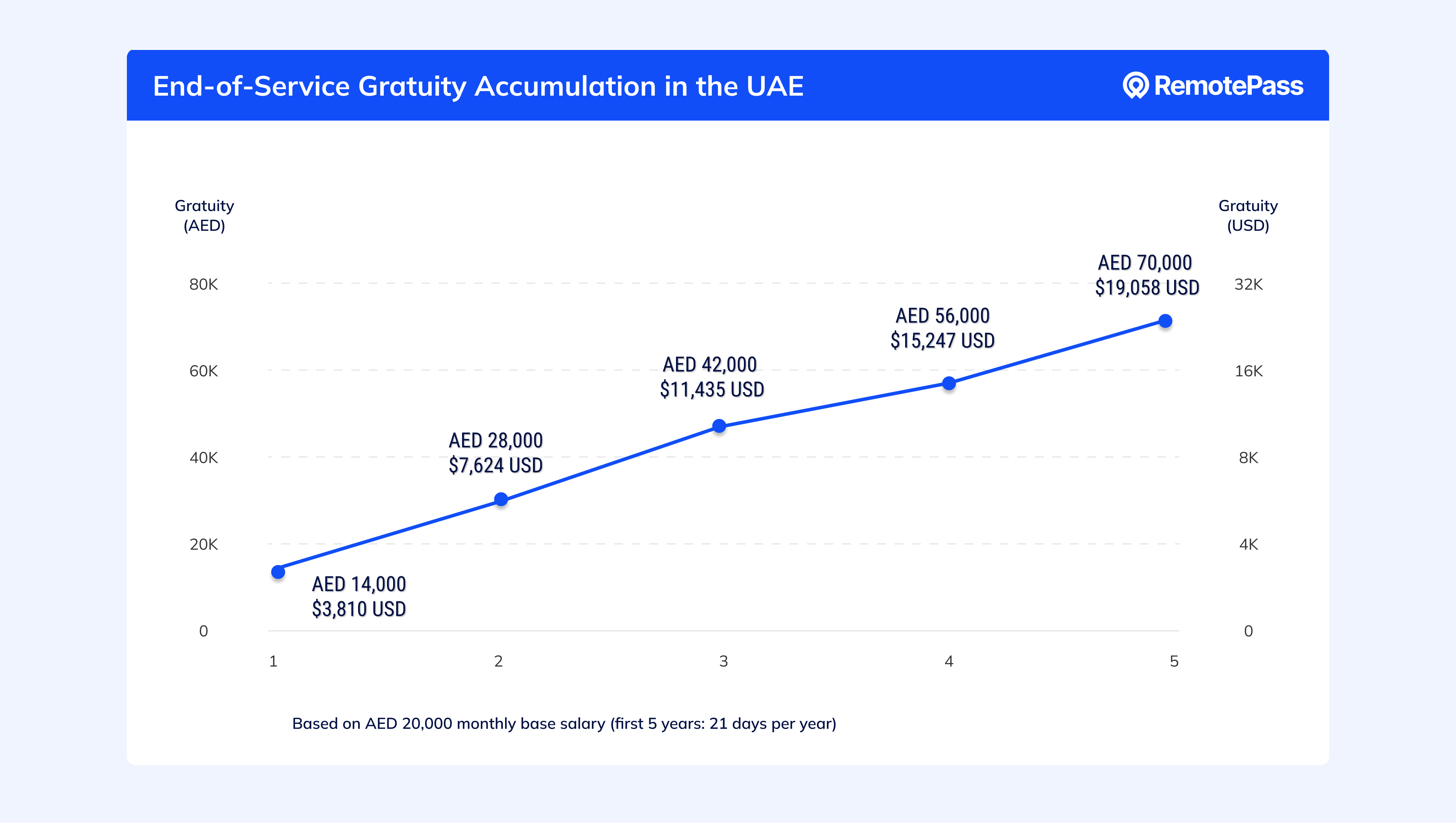
For example: If an employee earning AED 20,000 ($5,446 USD) monthly base salary leaves:
- After one year: ~AED 14,000 ($3,811 USD) owed
- After three years: ~AED 42,000 ($11,434 USD)
- After five years: ~AED 70,000 ($19,058 USD)
You’ll need to pay the full amount within 14 days. It's also a growing liability you need to plan for, especially if you're building a large team.
Those are all the mandatory hiring costs you can expect. But there are a few others you might not have taken into account.
Other Hiring Costs to Bear in Mind for the UAE
Beyond the obvious expenses, these costs can catch companies off guard.
Public Relations Officer (PRO) Services
In the UAE, a PRO (Public Relations Officer) isn't what you'd think from the name.
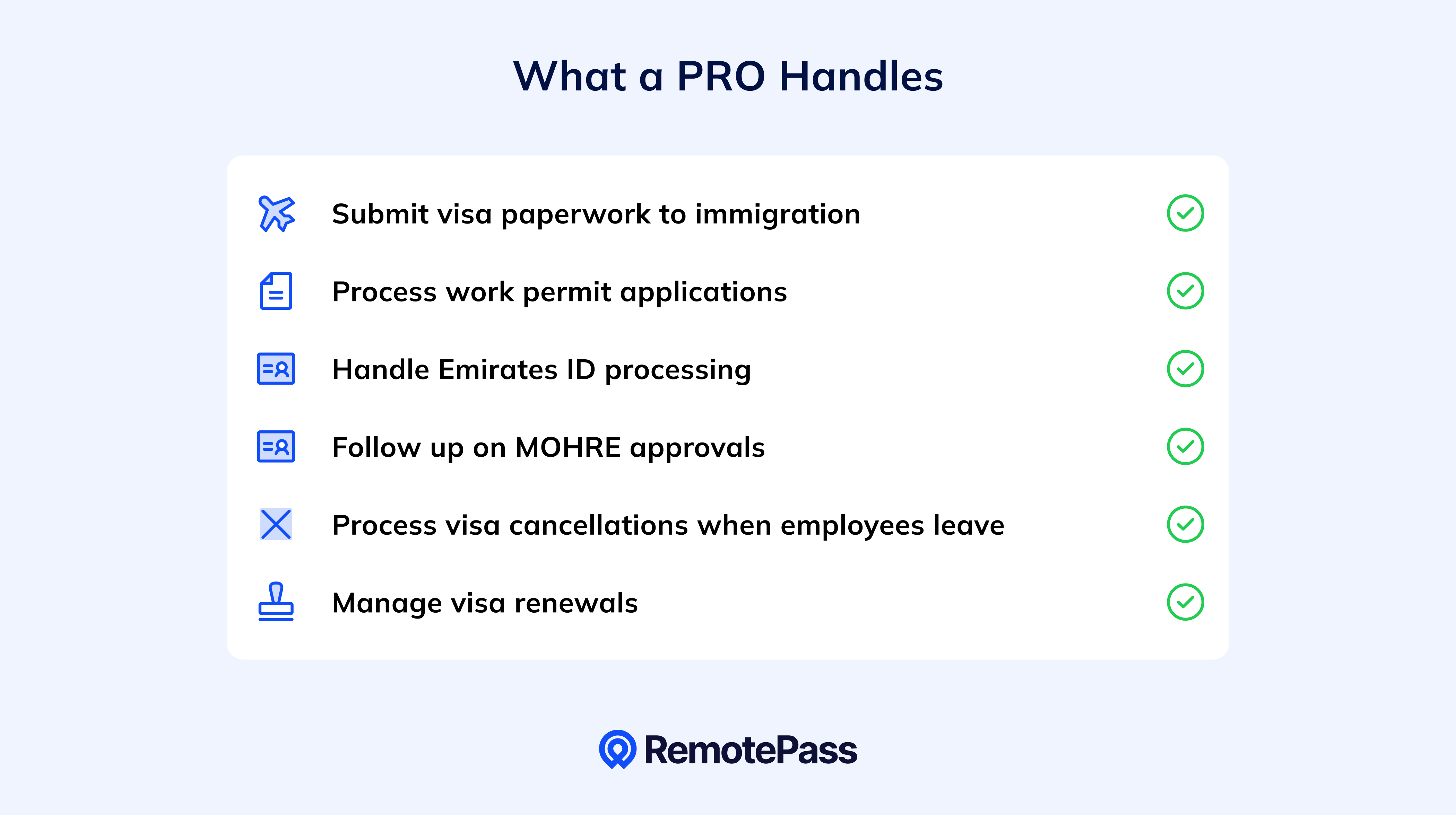
They don't handle marketing or comms. They're the person who deals with government authorities on your behalf: processing visa applications, submitting documents to MOHRE, following up on approvals, and handling all the paperwork that comes with sponsoring employees.
If you're setting up your own entity, you'll need a PRO. You can either hire one in-house (average salary is AED 5,500 ($1,497 USD) per month) or use a third-party PRO service. This cost is unavoidable unless you use an EOR.
Contract Translation and Attestation
Employment contracts must be in Arabic for MOHRE registration. You'll need to translate your contract and get it attested, meaning officially certified by government authorities that the translation is accurate and legitimate.
Expect to pay about AED 200–500 ($54–$136 USD) per contract for translation and attestation. Some companies skip this step and use English-only contracts, but if there's ever a labor dispute, MOHRE only recognizes the Arabic version. If you use an EOR, they handle contract translation and attestation as part of their service.
Relocation Support
If you're hiring from abroad, you'll typically cover flight tickets (AED 2,000–5,000 or $545–$1,362 USD depending on origin), temporary housing for the first few weeks (AED 8,000–25,000 or $2,178–$6,807 USD), and settling-in costs.
Some companies also advance the first month's housing allowance since employees need deposits for apartments.
Office Space Requirements
If you set up your own entity, many free zones require physical office space as a licensing condition, even if your team works remotely.
Flexi-desks start around AED 5,000 ($1,362 USD) annually. Small enclosed offices run AED 10,000–50,000 ($2,723–$13,615 USD) annually, plus utilities, furniture, and internet on top of license fees.
Visa Cancellation Fees
When employees leave, you pay to cancel their visa and Emirates ID. Budget AED 500–1,000 ($136–$272 USD) per exit.
You're also legally required to provide a return flight ticket if the employee requests it, though many employees waive this if they're staying in the UAE with a new sponsor or have their own travel arrangements.
How to Reduce Hiring Costs in the UAE
Once you understand where the costs come from, you can make strategic decisions to bring them down without compromising on talent quality.
Skip Entity Setup if You're Hiring a Small Team
Using an EOR means no license fees, no office requirements, no PRO fees. You pay a flat monthly rate per employee instead of tens of thousands upfront. This makes sense until you hit 10 or more employees, at which point setting up your own entity becomes more economical.
Hire in Lower-Cost Emirates
Dubai commands premium salaries because of cost of living and market competition. Sharjah, Ajman, and Ras Al Khaimah offer similar talent pools at a lower cost. If your team works remotely, location matters less.
Structure Compensation Strategically
Gratuity is calculated on base salary only. Sometimes it makes sense to offer a higher base with lower allowances rather than the reverse. You're giving the same total compensation but reducing your gratuity liability. Run the numbers both ways before finalizing offers.
Reduce Staff Turnover
Every departure means paying accumulated gratuity, canceling visas, and repeating the entire onboarding process for a replacement. Retention saves thousands per role.
Small investments in employee experience often pay for themselves through reduced churn. Things like more comprehensive health insurance or personal development budgets can encourage employees to stick around.
Negotiate Annual Contracts with Vendors
Insurance providers and PRO services often discount for annual commitments versus month-to-month arrangements. If you're confident about your hiring plans, annual contracts can cut 10–15% off recurring costs.
Batch Visa Processing
If you're hiring multiple people, process visas together. Many PRO services charge per application, but batch processing reduces the per-person cost. This only works if your hiring timeline allows it.
Final Thoughts on UAE Hiring Costs
The cost of hiring in the UAE is predictable once you understand the full picture. Salary is just the starting point. Government fees, mandatory benefits, and administrative costs drive the total 20–35% higher.
If you're hiring one or two people, an Employer of Record eliminates the biggest upfront costs and compliance risk. If you're building a larger team, you'll eventually want your own entity, but you don't need it on day one.
RemotePass handles the full employment stack: payroll, compliance, visas, insurance, and contracts. Book a 15-minute demo to see how you can hire in the UAE without navigating MOHRE yourself.
FAQs About Hiring Costs in the UAE
Is UAE hiring more expensive than Europe or the US?
Not necessarily. Salaries vary by role, but the absence of income tax often balances total compensation. What catches companies off guard is the upfront cost structure (visas, insurance, and entity setup) rather than the ongoing expense.
Do I need to provide health insurance?
Yes, if you're hiring in Dubai or Abu Dhabi. Other emirates are moving toward mandatory coverage as well. Budget AED 320–750 ($87–$204 USD) for basic plans that meet legal requirements, or AED 2,000–4,000+ ($545–$1,089+ USD) for mid-range plans that help attract talent.
Can I avoid paying gratuity?
No. It's a legal requirement under UAE labour law. You can't contract out of it, and employees can file complaints with MOHRE if you don't pay. The liability accrues from day one of employment.
Does using an EOR really reduce costs?
For teams under 10 employees, yes. You avoid entity setup (AED 9,000–40,000 or $2,500–$10,900 USD), office leases, PRO fees, and compliance overhead. For larger teams, the per-employee EOR fee eventually exceeds entity costs, and that's when companies typically switch to their own structure.
Can I hire UAE nationals without all these costs?
UAE nationals don't need employer-sponsored work permits or visas, so you skip those government fees entirely. They also typically have state health insurance coverage, which can reduce or eliminate your health insurance obligation. But you still need to accrue gratuity. The cost savings are real but not as dramatic as some companies expect.