.svg)



If you're searching for “Deel Alternatives,” you're probably not starting from zero. You either use Deel already and are a part of the 1225 teams on G2 feeling the pain of cost and navigation issues, or you're evaluating it alongside other tools and want to make the best choice for your business.
This guide gives you the shortlist of the best Deel alternatives, a quick comparison table, and a simple framework to help you choose the right platform for your budget, regions, and workforce model.
By the end of this guide, you should feel less overwhelmed and more confident, not just about which Deel alternative to choose, but about which services and features your company needs to scale internationally.
Quick Comparison Table: 7 Best Deel Alternatives
Use this table as your cheat sheet before getting into the details. At a glance, we have:
7 Best Deel Alternatives
Here's a more detailed explanation on where the 7 best Deel alternatives shine, fall short, and how they compare to Deel.
1) RemotePass
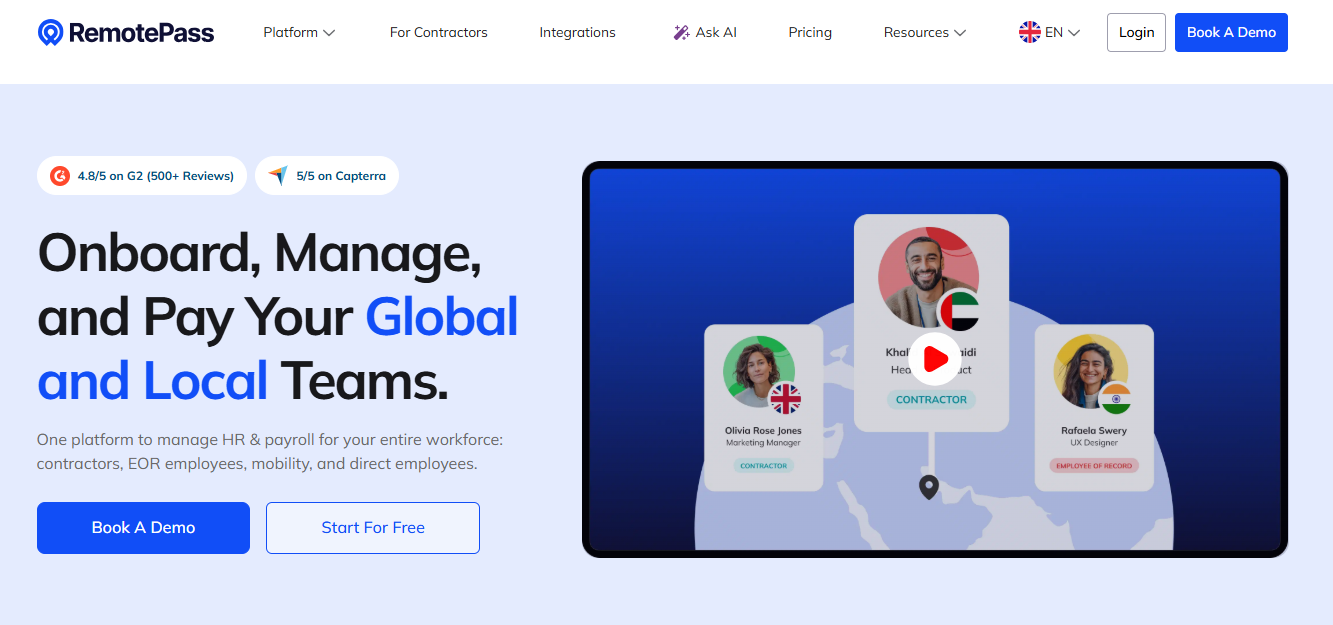
When you search for “Deel alternatives” you aren’t trying to replace a tool per se. You're looking for relief from the complexity, delays, and opacity that make global hiring harder than it should be.
RemotePass taps directly into that frustration by solving the problems most platforms tiptoe around: unclear pricing, poor support in emerging markets, and the chaos of juggling Employer of Record (EOR) employees and contractors in separate systems.
RemotePass focuses on doing fewer things exceptionally well, including compliant employment, payment, and management of global contractors and full time remote workers across 150+ countries.
Best for
Companies hiring across MENA, Africa, and emerging markets that want a modern, transparent, unified platform for both EOR employees and contractors.
Pricing
Clear, public pricing for employees and contractors starting at $15/mo for local payroll, $39/mo for contractors, $349/mo for EOR services, $299/mo for contractor of record and even an additional service of visa sponsorships starting at $549/mo.
You don’t need to “contact sales to find out.”
Where does RemotePass outperform Deel?
Depth of regional experience, responsiveness, and the local nuance required to execute reliably in emerging markets.
Where might Deel still win?
Large enterprises needing a sprawling HR ecosystem tied into IT, reporting, and advanced compliance tooling.
But for the typical global-first team building across emerging markets, RemotePass offers contractor management and Employer of Record services that provide clarity, support, and a frictionless experience.
2) Oyster

Oyster positions itself as the dependable, compliance-first alternative for companies hiring across well established local markets, especially Europe and North America, where statutory benefits and employment protections are stringent.
With Oyster, you can provide benefits, health insurance, retirement plans, PTO, and time tracking for your employees/contractor. You can also integrate Oyster with your HR tech stack.
Best for
Mid-size to enterprise companies with a diverse distributed workforce
Pricing
Oyster is typically priced per employee, with “from” amounts published for transparency. It allows for a 30-day free trial before the global payroll paid plan of $29/mo.
Where does it outperform Deel?
Oyster stands out as a Deel alternative in three ways:
- It provides dedicated account managers that help business scale without getting lost or ignored in generic support channels
- Oyster supports hiring in over 180+ countries as opposed to Deel’s 150
- It offers transparent flat rate pricing of $699 for its EOR service with no additional charge
Where might Deel still win?
If having more integrations is a box on your global HR platform to-do, then Deel might be your best choice here. Oyster has limited integration options that often need manual interference.
3) Remote
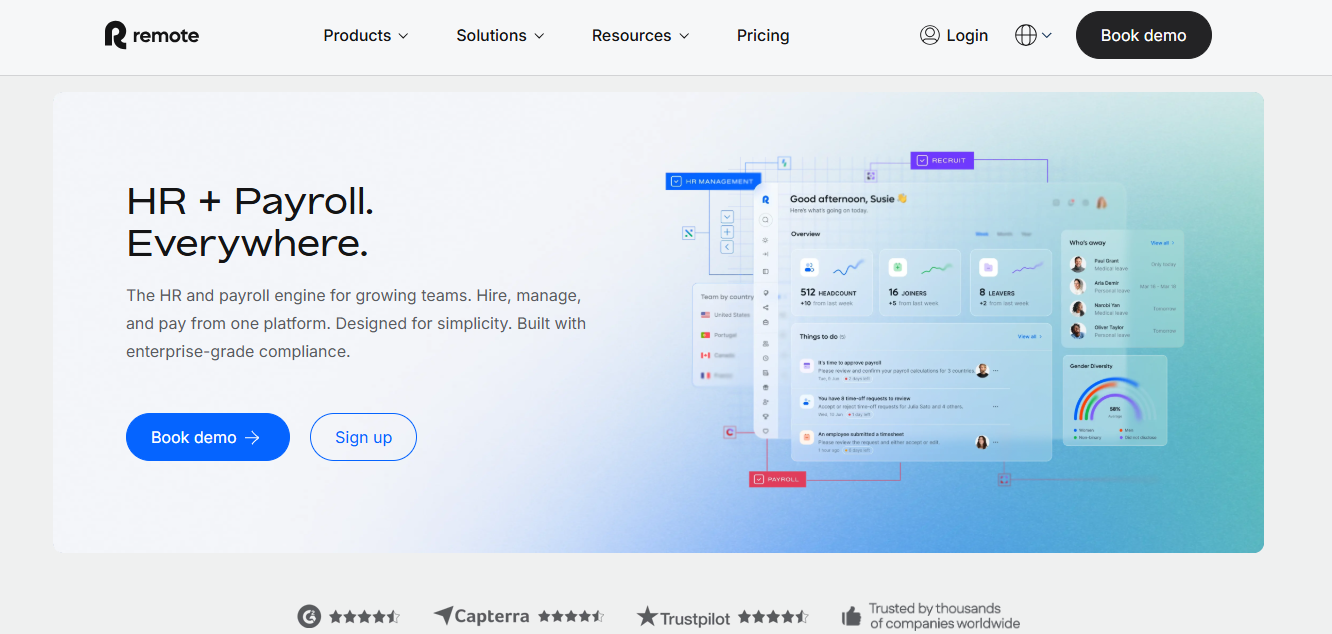
Remote covers the full employee lifecycle with in-platform workflows and support from people who know your countries.
Reviews on G2 consistently mention its ease of use, automation, compliance and support. It built its model around owning or directly controlling its legal entities in every country it supports rather than outsourcing operations to unknown partners.
That matters for companies that want to minimize compliance risk and avoid ambiguity about who’s doing what.
That kind of direct control brings a level of trust and reliability for teams expanding internationally, maybe into a handful of consistent countries rather than dozens at once. With Remote, you get:
- A unified EOR + full-time employment setup that removes the hassle of entity-creation or local legal registration.
- Built-in payroll, tax, and compliance management via the same infrastructure the vendor controls
Best for
Remote is best for companies building full-time teams in well-established markets (Europe, Canada, Australia, etc.) who want predictable compliance, owned entities, and clear workflows.
Pricing
Starts at $29/mo per employee for payroll and $699 per employee for an EOR.
Where Remote shines
Remote’s main strength is that it owns or directly controls its legal entities, which reduces the ambiguity that comes with partner-based EOR networks.
This gives risk-sensitive teams more confidence in payroll accuracy, benefits compliance, and contract enforcement.
Where Deel might still be a good fit
Remote has a narrower geographic reach (100+) for its EOR and payroll set up, especially in emerging markets where many teams plan to expand. Deel’s hybrid infrastructure (owned + partner + acquired entities) often results in broader, faster coverage.
If you need the most integrations and ecosystem breadth, Deel may still offer more versatility than Remote.
4) Rippling
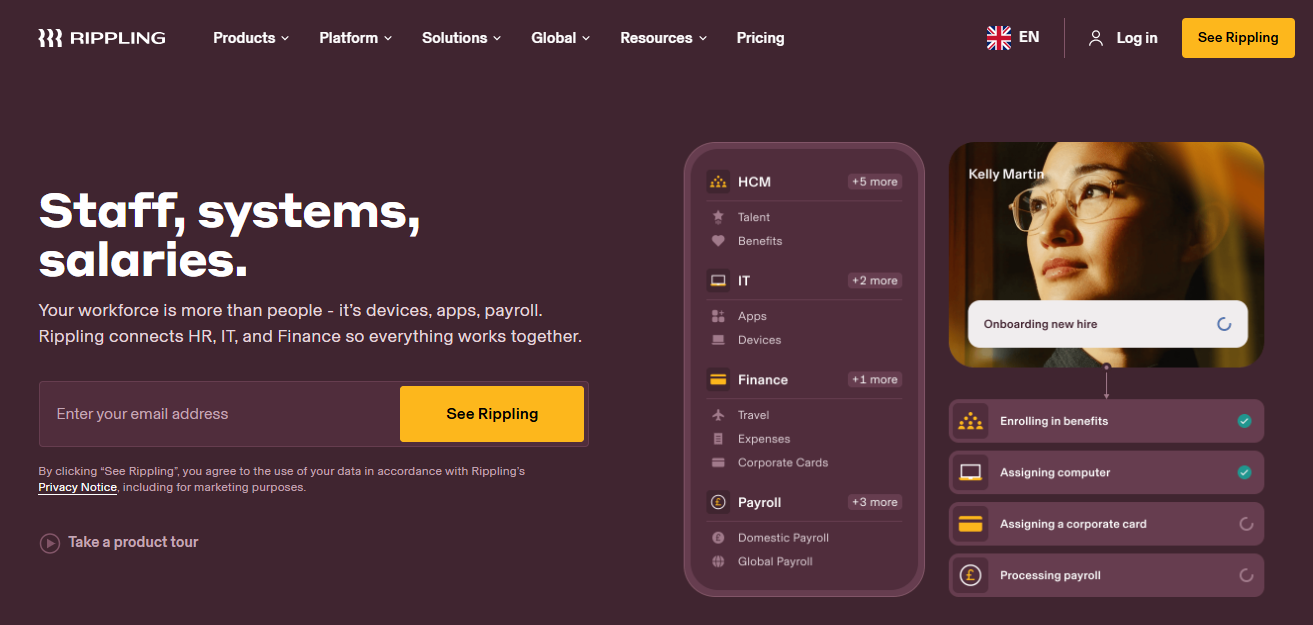
Rippling treats global employment as one tile in a larger mosaic, where HR, IT provisioning, device management, and operations are connected end to end in one system.
For companies that feel their internal operations are fragmented or overly manual, Rippling’s value is that: it consolidates everything into one infrastructure where onboarding, permissions, security, and payroll all run through the same workflows.
Best for
Ideal for enterprise hybrid and remote teams in need of automated IT management and global payroll.
Where Rippling shines
Rippling strength is in its infrastructure. Hiring someone abroad automatically triggers downstream tasks including configuring apps, shipping devices, granting permissions, setting up time-off policies, and integrating with finance. As a by-result, administrative load is reduced.
Where Deel might still be a good fit
Rippling requires more setup and process alignment than Deel. If your team’s primary need is simply to hire compliantly abroad without overhauling internal HR or IT systems, Deel’s more plug-and-play approach may be a better option.
5) Multiplier
Multiplier positions itself as the budget-friendly option that helps with employment, payroll, and compliance across many countries. For companies that want to hire internationally without stretching their budget, Multiplier is one to consider.
Best for
If you want something cost-effective, especially for full-time employees in Asia or other price-sensitive regions, Multiplier is often one of the easiest Deel alternatives to evaluate.
Pricing
Pricing starts at $40/mo to onboard contractors and $400/mo for an EOR. For comparison, RemotePass’s EOR fees start from $349/month, depending on the country.
Where Multiplier shines
Multiplier’s biggest strength is its pricing transparency. There are no hidden fees or extra charges on the platform.
Where Deel might still be a good fit
Compared to Multiplier’s reach of over 140+ countries, Deel has a wider range of over 160 countries to give you more choice in where you can hire, onboard, and pay talent compliantly.
6) Papaya Global
Papaya Global is a workforce management platform built for companies that operate across many countries and need payroll to run smoothly at scale.
It combines global payroll and EOR services so teams can hire, pay, and manage employees or contractors in 160+ countries while staying compliant.
If Deel feels too focused on hiring and not focused enough on payroll infrastructure, Papaya sits at the opposite end of the spectrum.
Best for
Papaya Global is best for mid-size and enterprise teams that already operate in multiple countries and want a unified payroll platform, not just help hiring a few people abroad.
Pricing
Papaya uses tiered, volume-based pricing, meaning costs per employee drop as your team grows. However, because pricing depends on headcount and service mix, you’ll need to go through sales to get exact numbers.
Where Papaya Global shines
Its strength is its global payroll infrastructure. Companies turn to it because they struggle with fragmented processes; separate payroll vendors, inconsistent reporting, and scattered data. Papaya centralizes everything.
Where Deel might be a better fit
Deel supports more hiring models out of the box including global contractors, equipment logistics, visa support, localized benefits, and a wider ecosystem of HR tools.
If you're building a lean international team or need a tool that works without heavy setup, Deel may feel more of a better choice. Papaya is strongest when payroll complexity is the main problem.
7) Pebl

Pebl is an established EOR provider that’s leaned heavily into automation in recent years. With its AI-powered platform, the company aims to make global hiring faster and smarter.
Pebl combines long-standing compliance expertise with real-time assistance. Teams can get instant guidance from Alfie, their AI compliance assistant, backed by insights from 200+ local legal experts.
Best for
If you value fast answers, AI guidance, and the ability to move quickly without sacrificing compliance, Pebl delivers that balance.
Pricing
Pebl uses custom, quote-based pricing, typically on the higher end of the market.
Companies with larger headcounts or complex hiring needs tend to negotiate more favorable rates, but smaller teams may find the upfront cost significant.
Where Pebl shines
Pebl’s advantage comes from combining two things teams often struggle to get in one place:
- Global hiring accuracy, built on years of EOR experience, and
- Automation, which reduces how long it takes to get compliance answers or move a hire forward
Where Deel might be a better fit
While Pebl speeds up the compliance side, its pricing and service model may feel heavy for smaller teams. Deel can be a better fit if you need a more flexible cost structure.
How to Choose the Best Deel Alternative for Your Business
Now that you've seen the best 7 Deel alternatives, here's how to choose the best one for you and your team.
Here’s the decision framework that separates high-performing global teams from the ones stuck in vendor purgatory.
1. Know what service you actually need
Many tools look similar on the surface, but they work very differently under the hood, and choosing the wrong one can mean higher costs or compliance risk.
Ask these questions before you compare vendors
- Do you actually need EOR, or are you misclassifying contractors?
- Do you need global payroll because you already have local entities?
- Do you need both employees and contractors on one platform?
- Are you optimizing for speed to hire, compliance risk, or payroll complexity?
What to remember
- EOR is the safest option when the role should legally be employment and you don’t have an entity
- Contractor management/CoR is ideal for contractors, but it’s not a substitute for EOR if the role should be employment
- Global payroll assumes you already have a registered company in each country, so it’s not the same as EOR
Once you’re clear on the model, then features matter. For example: RemotePass is a strong fit when you need both EOR and contractors in emerging markets.
Papaya tends to work when payroll complexity is the core problem; and Rippling can be a better fit when HR, IT, and finance need to be unified.
Even a “great” tool will fail you if it’s the wrong category for your needs.
2. Evaluate regions based on operational strength, not marketing claims
All the HR platforms say they support 100+ countries. But, that shouldn't be your sole focus.
The real questions are:
- In which countries do they own entities?
- Where do they rely on partners?
- Where do they have real on-the-ground expertise?
- Where do clients experience delays or compliance struggles?
To validate a provider’s country coverage, ask whether your priority countries are supported via owned entities or partners, confirm timelines and compliance ownership, and cross-check with customer reviews or references for those same countries.
3. Choose a pricing model that scales with you
Pricing can be a growth constraint if your costs jump unpredictably as you add hires, countries, or add-ons like benefits.
Note these down:
- If your team will double, will your vendor price double?
- If benefits are add-ons, how much will they cost?
- Does the vendor lock you into annual terms?
- Are there offboarding or contract amendment fees?
RemotePass and Multiplier appeal to early-stage teams because their pricing is predictable.
Deel and Velocity Global often appeal to enterprises because their pricing is negotiable at scale.
4. Match implementation speed to business urgency
If you need to hire a candidate abroad tomorrow, you can’t choose a vendor whose onboarding cycle runs for weeks. RemotePass, Multiplier, and Remofirst win here. Rippling and Papaya offer richer ecosystems. but require more upfront setup.
Choose a faster-to-implement provider for urgent, one-off hires or new-country launches. A slower, heavier platform might be a better option when you’re hiring at scale and need deeper systems and integrations.
5. Consider integration density only if you truly need it
Rippling and Deel have massive (over 100) integration catalogs which can be quite transformative for companies with dozens of systems.
However, if your company has a simple stack, it’s irrelevant. Do a quick audit of the systems you use today (HRIS, payroll, accounting, SSO, expenses) and list the integrations you actually need.
Add what you realistically expect to adopt in the next 6–12 months. If that list is short, you probably don’t need an “enterprise” platform with multiple integrations.
Final thoughts on Deel alternatives
Finding the right Deel alternative comes down to choosing a partner you can trust with your global team. One that makes hiring, compliance, and payments feel straightforward instead of stressful.
If you’re hiring in MENA, emerging markets, working with mixed teams of employees and contractors, or needing transparent pricing, you should get started with Remotepass.
You’ve compared your options. Now see the difference for yourself. Book a demo with RemotePass and experience global hiring that feels effortless.


.svg)





.svg)